
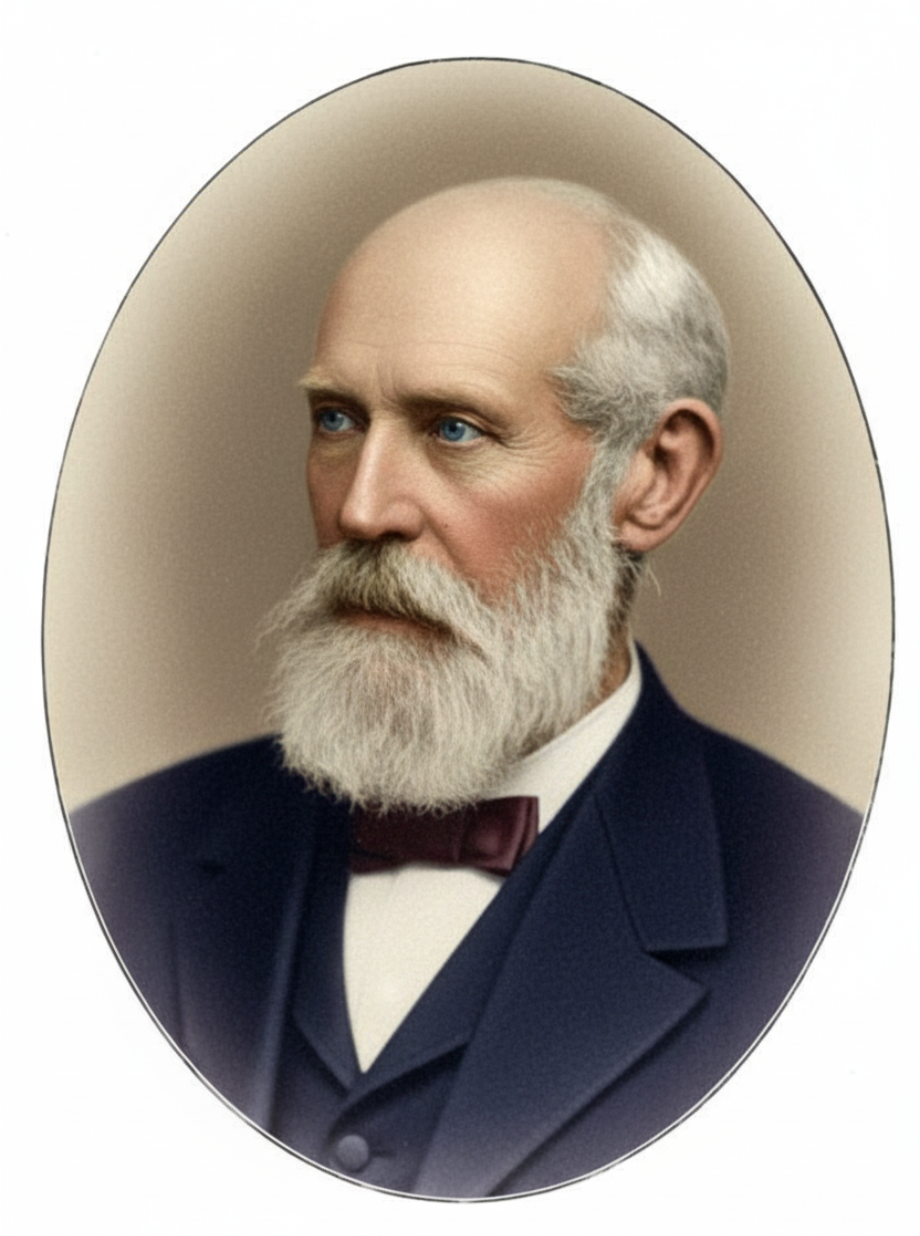
- Years of Life: 1817-1899
Early Life and Conversion
William Talbot Crosbie was born in 1817, a member of one of the landed Protestant families of County Kerry, and later became the owner of Ardfert Abbey. He was brought to Christ as a very young man, and from early adulthood possessed a sincere personal faith, though for many years it moved within the ordinary channels of evangelical Anglican life.
After a prolonged minority, he entered upon the management of his large estate, a responsibility he accepted with seriousness and energy. He married young, his wife being a sister of the late Lord Gwydyr, and together they devoted themselves to the careful reorganisation of the farms and the instruction and welfare of their tenants.
Estate Management and the Famine Years
Mr. Crosbie proved himself an able and far-sighted landlord. By introducing sound agricultural measures and restructuring the estate in good time, he placed Ardfert on a footing of stability. When the Great Famine swept through Ireland, these preparations proved providential. While devastation was widespread elsewhere, the Ardfert estate was preserved, largely through the foresight and diligence of its owner.
Yet it was not economic wisdom alone that would come to define Crosbie’s life.
The Revival of 1861 and Spiritual Transformation
The Revival of 1861, which first made itself felt in Ulster, soon spread southward, and Kerry was powerfully affected—particularly among the Protestant population. Alongside R. J. Mahony and F. C. Bland, William Talbot Crosbie became one of three Kerry landlords whom God brought into remarkable prominence during this movement.
Though already a Christian, Crosbie underwent a profound spiritual deepening. The revival marked for him:
-
a new liberty in Christ
-
a fuller joy in salvation
-
deeper separation from the world
-
wholehearted devotion to his Master
-
a call to active service in the Word and the Gospel
This was not a passing excitement but a complete transformation of character and direction.
Ardfert Abbey as a Centre of Revival
Ardfert Abbey became one of the chief centres of revival blessing in Kerry. Meetings held in the granary at Ardfert began during this period and continued uninterrupted for many years. Powerful scenes of awakening occurred there and in nearby Tralee, under the ministry of J. Denham Smith, T. Shuldham Henry, and many others whom Crosbie personally invited to Kerry and accompanied in their labours.
The influence extended to his own household. According to John Hambleton, every servant in the Abbey had been converted, and many became active workers in the Gospel. Hambleton records a memorable meeting in a loft at Ardfert, where over one hundred converts, Bibles open, listened intently to the exposition of the Word, in a season so marked by the presence of God that it seemed “Heaven had come down to earth.”
Withdrawal from Public Office and Consecration to Gospel Service
Before the revival, Crosbie had been deeply involved in county, political, and fiscal affairs. As Grand Juror and Justice of the Peace, he had laboured with conspicuous ability and leadership. But the revival changed everything.
So vivid and real to him became:
-
his position in Christ
-
his heavenly inheritance
-
and the near return of the Lord
that, after much prayerful consideration and not without deep personal cost, he resigned his deputy lieutenancy and magistracy, withdrew from public life, and gave himself to:
-
the service of the Gospel
-
the quiet labour of his home farm
-
the generous hospitality of his Christian home at Ardfert Abbey
Christian service now held the first place in his heart.
Evangelistic and Missionary Labours
William Talbot Crosbie’s service was neither local nor passive. Alongside Mr. Mahony and Mr. Gordon Oswald, he preached the Gospel in Naples and other parts of Italy, sharing in foreign evangelistic labour.
Closer to home, he worked extensively in and around Lurgan, where for many years he bore the principal financial burden of the Gospel mission. Wherever he travelled, he was ready to testify for Christ, showing great wisdom and tenderness in personal conversation with friends, guests, and even casual acquaintances.
Fellowship and Ecclesiastical Convictions
For over twenty-five years, Crosbie was a constant attendant and frequent speaker at the Dublin Believers’ Meetings, which he greatly loved.
Though raised in the Evangelical Church of England, the revival awakened searching inquiry into doctrines he had previously accepted without question. Among these were:
-
infant baptism
-
apostolic succession
-
priesthood
-
episcopal ordination
As a result, he and his family chose to meet simply as Christians, without denominational affiliation, gathering only on the ground of the Name of the Lord Jesus Christ for worship, prayer, ministry, and the Lord’s Supper.
Humility, Faith, and Final Testimony
Among his private papers was found a deeply revealing statement, expressing his lifelong convictions. He requested that, should he die before the Lord’s return, his funeral be conducted “in the simplest and most unsectarian manner possible,” having renounced all sectarian connection and believing Christianity to be far higher than any human system.
He described himself simply as:
“A sinner saved all of grace, having no claim whatever to any merit of my own, but resting solely on the all-sufficient merits of my adorable Saviour, in whom alone I have trusted since my conversion in 1839, and who has supplied all, all my need, in spite of all my failures.”
Death and Burial
William Talbot Crosbie passed away on 4 September 1899, at the age of 82. He was buried in the ancient ruined Cathedral of Ardfert, a fitting resting place for one whose life had been so deeply bound up with the spiritual history of the district.
The burial service was conducted by his two younger sons and his son-in-law, bearing witness to the godly heritage he left behind.
Legacy
William Talbot Crosbie is remembered as:
-
a landlord transformed by revival
-
a man who relinquished position for Christ’s sake
-
a tireless supporter and preacher of the Gospel
-
a bridge between revival power and lasting church testimony
-
a humble believer who gloried only in grace
His life stands as a vivid testimony to the enduring fruit of the Revival of 1861, and to the power of a heart fully surrendered to Christ—“a sinner saved all of grace.”