
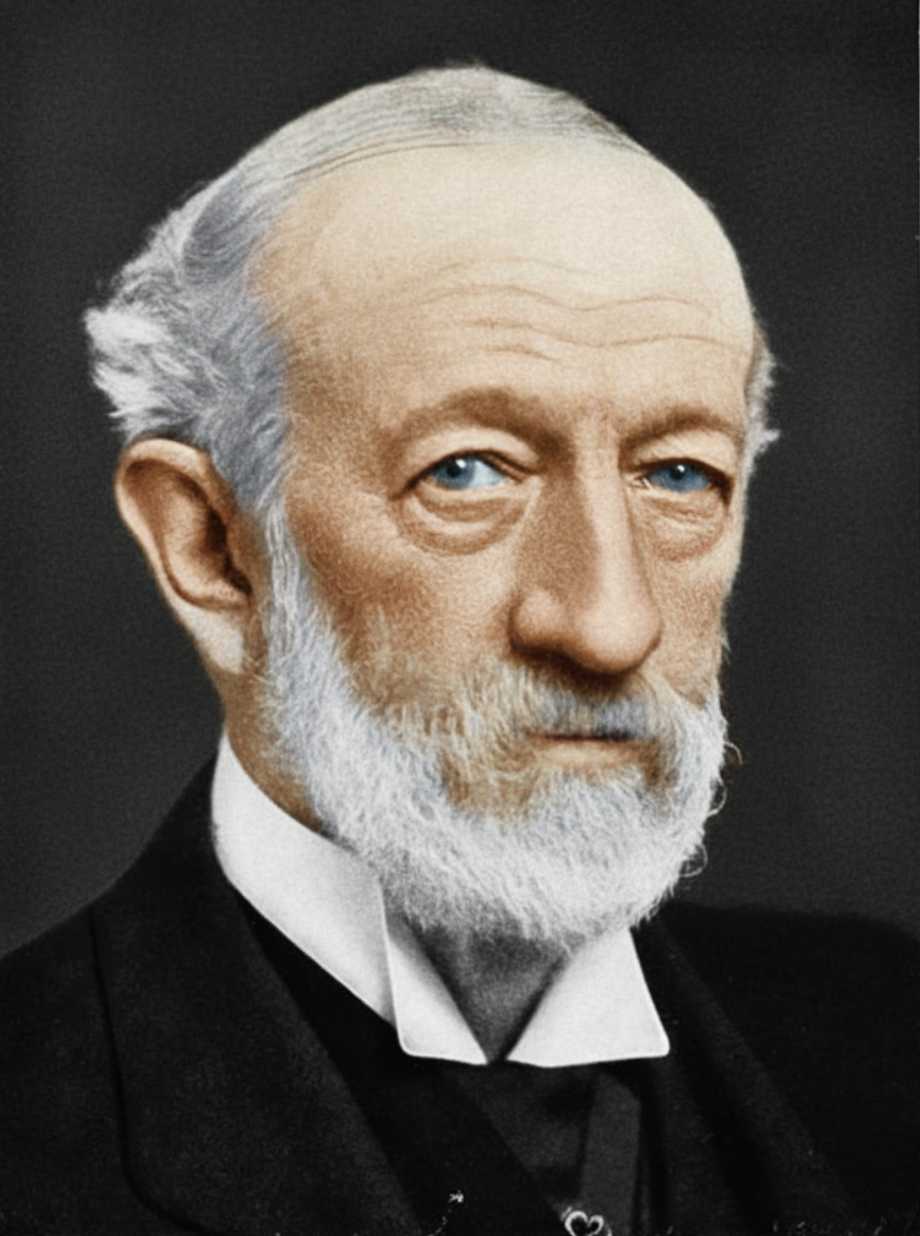
- Years of Life: 1841-1918
Early Life
Sir Robert Anderson was born in Dublin on 29 May 1841, into a family of strong Scottish and Protestant heritage. His father, Matthew Anderson, served as Crown Solicitor in Ireland and traced his ancestry to the defenders of Derry during the famous siege of 1689. Robert was raised in a disciplined, intellectually serious, and religious household, where Christianity was respected and moral duty strongly emphasised.
Though surrounded by Christian influences from childhood, Anderson later acknowledged that his early faith was more outward and intellectual than personal. He lived what he described as a religious life, marked by moral seriousness and occasional spiritual concern, but without settled peace with God.
Education and Legal Training
After completing school, Anderson was initially given an excellent opportunity in business, entering employment with a large brewery. However, after eighteen months he turned away from commerce, feeling drawn instead toward academic and professional life.
He entered Trinity College, Dublin, where he distinguished himself as a gifted scholar. In 1862, he graduated Bachelor of Arts, receiving both a Moderatorship and a medal—high academic honours. He later received the degree of Doctor of Laws (LL.D.) from the same institution in 1875.
Following further study in Boulogne and Paris, Anderson trained for the legal profession and was called to the Irish Bar. His sharp analytical mind, mastery of evidence, and calm reasoning soon set him apart.
Conversion and Spiritual Turning Point
The decisive spiritual turning point in Anderson’s life came in 1860. The conversion of one of his sisters during meetings led by J. Denham Smith awakened deep spiritual concern within him. Although initially resistant, Anderson agreed to attend a service in his own church where the preacher was Rev. John Hall (later of New York).
That sermon deeply disturbed him. The preacher boldly proclaimed forgiveness of sins and eternal life as God’s free gift, to be received immediately by faith. Anderson objected strongly, considering such teaching unscriptural. After the service, he challenged the preacher directly.
During their walk home, the minister stopped, looked him squarely in the face, and said with solemn authority:
“I tell you, as a minister of Christ and in His Name, that there is life for you here and now if you will accept Him. Will you accept Christ, or will you reject Him?”
After a long pause, Anderson replied: “In God’s Name, I will accept Christ.” He later said that from that moment, the peace of God filled his heart. This experience marked the true beginning of his Christian life.
Public Service and Scotland Yard
In 1865, Anderson began assisting the Irish Government in cases involving treason and political conspiracy. His deep understanding of revolutionary movements and conspiratorial methods brought him to the attention of senior officials.
He was appointed Irish Agent at the Home Office, and later became Chief of the Criminal Investigation Department (CID) at Scotland Yard. He held this position during one of the most turbulent periods in British policing, including the era of the Jack the Ripper murders.
Anderson served the public for thirty-five years, earning a reputation for integrity, courage, and unwavering loyalty to duty. In 1901, upon retirement, he was appointed Knight Commander of the Bath (K.C.B.), a public recognition of his distinguished service.
Parliamentary leaders publicly commended his work, and later commentators observed that the nation owed him a far greater debt than it realised.
Marriage and Personal Life
In 1873, Anderson married Lady Agnes Moore, sister of the Earl of Drogheda. She proved to be a devoted and capable partner, deeply involved in Christian service and women’s work in London. Their marriage was marked by mutual respect, hospitality, and shared spiritual purpose.
Despite his demanding public career, Anderson maintained a disciplined personal life, marked by study, writing, and deep engagement with Scripture.
Christian Witness and Brethren Associations
Throughout his life, Anderson was closely associated with assemblies linked to the Brethren movement, attending Merrion Hall in Dublin and later gatherings in Camberwell and elsewhere in London. His orderly mind sometimes struggled with aspects of open ministry, yet his heart remained warmly aligned with the core Brethren principles of Scripture authority and salvation by grace alone.
His ministry at conferences—especially the Half-Yearly Meetings in Glasgow—was highly valued for its clarity, depth, and intellectual honesty.
Author and Defender of the Faith
Sir Robert Anderson’s influence extended far beyond policing through his prolific and powerful writing. Though he also authored works on crime and politics, it is his theological books that have secured his lasting reputation.
Among his most significant works are:
-
The Gospel and Its Ministry
-
Human Destiny
-
The Silence of God
-
The Coming Prince
-
Daniel in the Critics’ Den
-
The Bible and Modern Criticism
-
A Doubter’s Doubts about Science and Religion
-
The Lord from Heaven
His book The Coming Prince, on the prophecy of Daniel’s seventy weeks, became a classic of prophetic interpretation. The Silence of God, written during the upheavals of the early twentieth century, profoundly helped readers struggling with suffering and unanswered prayer.
What made Anderson’s writing so compelling was not merely scholarship, but certainty. He wrote as one who believed truth could be known, defended, and proclaimed clearly. Readers were often struck by his refusal to compromise with theological vagueness or modern scepticism.
Final Years and Home-Call
In his later years, Anderson continued to write and correspond widely, even as his health declined. After a bout of influenza, he appeared to recover, worked late one evening, retired to rest, and passed peacefully into the presence of his Lord on 15 November 1918, at the age of 77.
His life united intellectual brilliance, public service, and unwavering Christian conviction—a rare combination. Few men have served both Crown and Christ with such distinction.
Legacy
Sir Robert Anderson remains remembered as:
-
A brilliant legal mind and public servant
-
A fearless defender of biblical Christianity
-
A clear, disciplined, and influential Christian writer
His books continue to be read, studied, and quoted more than a century later, bearing witness to a man whose faith was reasoned, tested, and deeply personal.