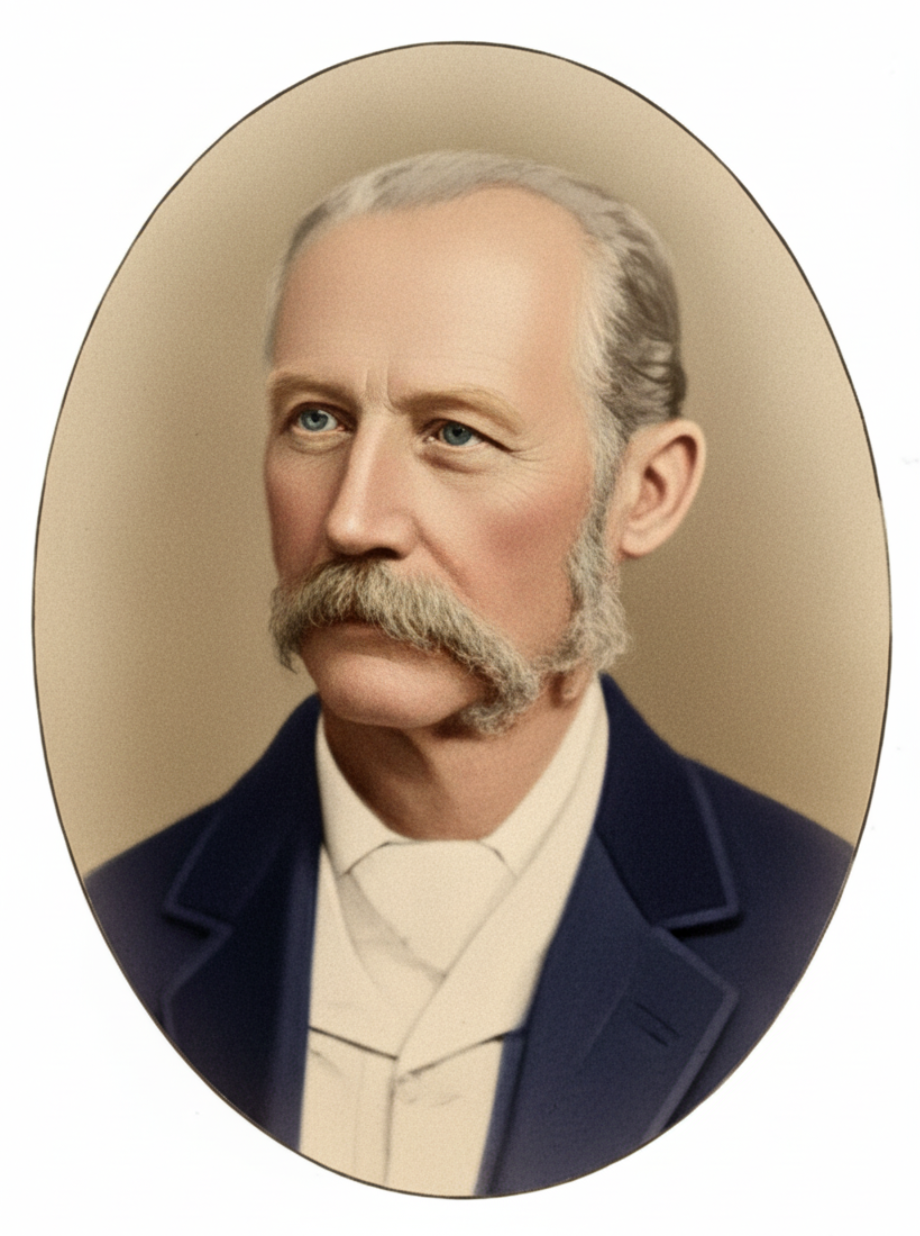
- Years of Life: 1827-1892
Early Life, Inheritance, and Responsibility (1827–1856)
Richard John Mahony was born in 1827 into a landed family in County Kerry, Ireland, and in early manhood succeeded to Dromore Castle upon the sudden death of his father during the years of the Great Potato Famine. Though naturally fitted—by intellect, presence, and education—for a public or political career, Mahony chose a different path. He devoted himself to the welfare of his tenantry and neighbours, applying energy, resources, and personal care to improving the material and moral condition of the estate.
Under his oversight, Dromore became a model estate, so much so that even the Dublin Freeman’s Journal—a publication habitually hostile to the Irish landed gentry—was compelled to acknowledge the excellence of his administration. This practical benevolence was not merely philanthropic; it was the fruit of a conscience increasingly exercised before God.
In 1856, Mahony married Miss Wailer of Limerick, who proved to be, in the fullest sense, a true helpmeet, sharing with him every labour undertaken for the good of others and the glory of God.
The Kerry Revival and the Work at Dromore (1861)
Although the great Ulster Revival of 1859 had swept powerfully through the north of Ireland, its influence had scarcely touched the southern provinces. That situation was sovereignly changed in January 1861, through what outwardly appeared a simple event.
At a meeting held in the great hall of Dromore Castle, Mahony spoke briefly and from the heart on the love of God and the redeeming work of Christ. God was pleased to use these few words as the spark that kindled a wide and deep spiritual awakening throughout the parish and beyond.
In a circular letter written in March 1861, Mahony described the work in these terms:
“It pleased God to bring some of us together near the beginning of the year to ask Him to give us the true saving knowledge of Him in our hearts… There are now nightly meetings throughout the parish for prayer and praise to Almighty God, and there are men who a short time since never spoke or thought of religion… yet now stand up with burning hearts to tell of what great things God has done for them.”
The revival spread rapidly. Nightly meetings were held; hardened men were converted; prayer and praise replaced indifference and vice; and the spiritual atmosphere of the district was permanently altered. The movement later became known as the “Kerry Revival.”
Personal Assurance and Lifelong Devotion to Christ
Shortly after these events, C. H. Mackintosh addressed a meeting at which Mr. and Mrs. Mahony were present. Through the ministry of the Word on that occasion, both were brought into the full assurance of eternal life in Christ. From that hour, Mahony’s already earnest Christianity deepened into a life wholly surrendered to the service of the Lord.
A lifelong friend later wrote:
“To treat in detail of the far-reaching effect of the work begun through him would need a volume; nor would it be expedient to name the many gifts to the Church whose conversion might be traced directly or indirectly to the work begun at Dromore.”
Many who later became prominent servants of Christ in Ireland and beyond could trace their spiritual beginnings to that work.
Friendship with F. C. Bland and Wider Ministry
Mahony’s closest spiritual companion was F. C. Bland of Derriquin, whose life ran in remarkable parallel with his own. The two men were often likened to Jonathan and David, united in affection, purpose, and devotion to Christ. Yet Mahony’s personality was distinct and strongly marked.
Ill-health compelled him to spend long periods away from Ireland. During these absences he preached in Edinburgh, and later travelled extensively on the Continent. Wherever he went—whether in churches, halls, or fashionable hotels—he sought opportunities to preach Christ. Not a few among the rich and noble were brought to God through his testimony.
He was a man of commanding presence, combining dignity with gentleness, intellectual power with childlike simplicity. His manner was marked by exquisite courtesy, and his speech by clarity and restraint. The Times aptly observed of him:
“He possessed in a marked degree the special graces of Irish oratory, without any of its extravagancies.”
Behind the public gifts lay a heart aflame with love to God, and a life wholly consecrated to His service. Hence the crowds that gathered to hear him, and the unmistakable blessing that attended his ministry.
Writings and Literary Gift
Though gifted as a writer, Mahony used his pen sparingly, to the Church’s great loss. Yet what he did write was of rare quality. Among his writings were:
-
The Real Presence and the Royal Priesthood
-
Liberty Not Licence
-
Eternal Salvation and How the King Died and the Murderer Went Free
-
Short and touching tracts such as “Father Martin”
These writings reveal depth of thought, clarity of doctrine, and a tender pastoral spirit. They remain valued for their spiritual beauty and Scriptural soundness.
Final Years and Home-Call (1892)
In the summer of 1892, Mahony’s speech became affected, and with it came the painful realisation that his public preaching was at an end. At first this trial was keenly felt. But grace quickly triumphed. Again and again he was heard quietly repeating:
“The good Lord knows best.”
And at other times:
“Some day! Some day!”
Adding softly:
“The good Lord knew best, and some day we shall understand it all.”
Thus chastened yet peaceful, he awaited his Master’s call. On 22 December 1892, Richard J. Mahony departed to be with Christ, at the age of 65.
Legacy
Over his life may truly be written the simple yet comprehensive epitaph:
“He served the Lord Christ.”
Landowner, revival instrument, evangelist, author, and gentleman, Richard J. Mahony stands among the noblest figures of the Irish revival era—a man greatly beloved, whose influence extended far beyond his own generation, and whose works continue to speak, though he rests from his labours.