
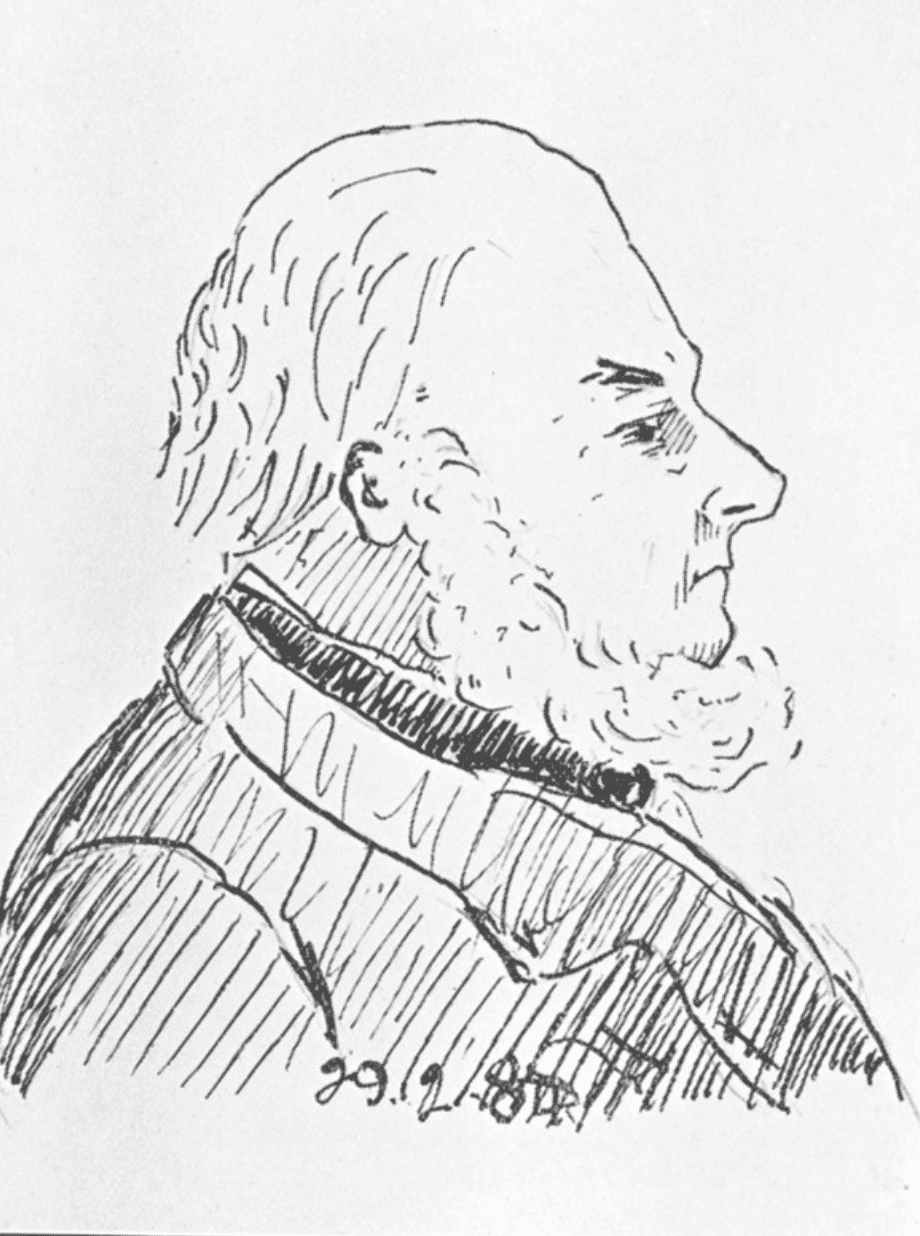
- Years of Life: 1820-1889
Early Life and Background
John Hambleton was born at Toxteth Park, Liverpool, England, and was brought up amid the bustling life of that great seaport. From his earliest years he enjoyed the priceless advantage of a godly mother, whose reverence for the Holy Scriptures and consistent Christian walk left an indelible impression upon his young heart. She not only taught him the truths of the Word of God but lived them before him daily, and her influence formed one of the strongest links in the chain that ultimately led to his conversion.
Yet, despite such privileges, Hambleton’s youth was marked by restlessness and rebellion. While still a lad he disobeyed his mother, fell into evil company, and was drawn into sin and vice. At the age of sixteen he ran away from home and entered the theatrical profession, a step that took him far from the restraints of his upbringing and plunged him into a wandering, adventurous life.
Years of Wandering: Actor, Adventurer, Gold Digger
For sixteen years John Hambleton travelled extensively in Australia and America, living successively as an actor, theatrical manager, adventurer, and gold digger. He moved in circles often hostile to Christianity, associating with infidels and scoffers, and frequently hearing objections to and ridicule of the Bible. Yet, remarkable as it may seem, he later testified that throughout all those years he never doubted the divine authority of the Scriptures.
“In my own heart,” he wrote, “I believed every doctrine of the Christian faith, though I was a rejecter of Christ and a neglecter of God’s great salvation.”
When news reached him of the discovery of gold in California, he resolved to leave Australia and try his fortune on the diggings. After arriving in San Francisco and making his way inland, he passed through experiences of grave danger. On one occasion his companions actually dug his grave, believing he was about to die. As he lay beneath a tree, seemingly at the point of death, conscience awoke with terrible power.
The scenes of his past life rose vividly before him—his broken home, his mother’s wounded heart, abused talents, despised grace, and the awful prospect of eternity without Christ. Though restored to health, this solemn awakening did not at once lead to conversion, and he resumed his wandering life.
Return to England and Conversion
In a striking providence, after seventeen years’ absence, Hambleton returned to England, landing in Liverpool on April 1st, 1857. Seeking his family, he eventually found his sisters, but learned that his mother had died some years earlier. Before her departure to be with Christ she had made her daughter write down a declaration of her faith—that God would save her son John and bring him back to Liverpool to become a Gospel preacher. That paper proved, in after years, to be a precious testimony to the power of a praying mother.
Convicted of sin and longing for peace, Hambleton tried to become “religious,” but soon discovered that self-effort brought only weariness. At length, through faith in Christ, he obtained peace with God, and immediately a burning desire sprang up within him to win souls for the Saviour who had so graciously sought and saved him.
Early Gospel Labours
He began at once to witness for Christ in the open air, learning by experience how to endure hardness as a good soldier of Jesus Christ. After a period of apprenticeship in this work, he and Edward Usher hired the Teutonic Hall in Liverpool for Gospel meetings, where a richly blessed work followed and hundreds professed conversion.
Soon afterwards, with a fellow-labourer and only a shilling between them, Hambleton went forth in simple dependence upon God to preach the Gospel in the towns of Lancashire. They were unsent by sect, society, committee, or party, but went out trusting the Lord alone. Later Henry Moorhouse joined him, and together they laboured in fairs, races, shows, and other crowded gatherings, distributing tracts and proclaiming with power the great Gospel themes—ruin by the fall, redemption by the blood, and regeneration by the Holy Spirit.
Alongside Richard Weaver and Henry Moorhouse, Hambleton formed part of a remarkable trio of evangelists whom God greatly used during those years. Though less widely known than the other two, he was none the less gifted in his own distinctive sphere.
A Fearless Open-Air Evangelist
John Hambleton was a bold and fearless ambassador of Christ, possessing a magnificent voice, great command of language, and remarkable readiness of speech. He excelled as an open-air preacher, undeterred by opposition or ridicule.
Many incidents from his evangelistic career illustrate both his courage and his spiritual discernment. On one occasion, while preaching on a racecourse, he was seriously disturbed by a group of rough men led by a Romanist agitator. Hambleton invited the ringleader to speak on condition that he would answer a single question. When the man accepted and mounted the platform, Hambleton asked solemnly, “Why did Cain murder his brother Abel?” The question struck home with convicting power; the man fled from the platform deeply troubled, and the evangelist was enabled to proclaim salvation through the precious blood of Christ.
At another time, when preaching at a fair, showmen sent a clown—painted and grotesquely dressed—to mock the meeting and distribute handbills. Hambleton instantly turned the situation to account, contrasting service for Satan with service for Christ. The clown withdrew in confusion, but later sought out the “converted actor,” confessing his misery and asking for prayer.
Writings and Wider Service
Hambleton was also used of God with the pen. His best-known work, Buds, Blossoms and Fruits of the Revival (1870), records scenes and lessons from the great revival movements of his day, while The Converted Actor, written by E. H. Bennett, preserves the story of his remarkable conversion and subsequent ministry.
For thirty years he laboured throughout England, Scotland, and Ireland, preaching in the open air, tents, halls, chapels, theatres, and even circuses. For a period he also engaged in Bible carriage work, and travelled widely lecturing with a large prophetic chart known as “Ezekiel’s Tile,” expounding God’s purposes with Israel and the nations.
Final Years in Australia and Home-Call
The last ten years of John Hambleton’s life were spent in Australia, where he continued to labour with undiminished zeal until strength failed. Even far from his native land, his heart burned with love for souls and devotion to Christ.
He received his Home-call in Australia on December 8th, 1889, at the age of sixty-nine. Thus ended a life that had been wondrously transformed by grace—from runaway youth and wandering actor to fearless evangelist and herald of the Gospel.
Legacy
John Hambleton’s life stands as a powerful testimony to the saving grace of God and the value of a praying mother. He feared not the face of man, refused to be bound by sect or party, loved all the brethren, and sought only to be guided by the Scriptures. Truly he was a “burning and shining light,” and though he rests from his labours, his works do follow him.