
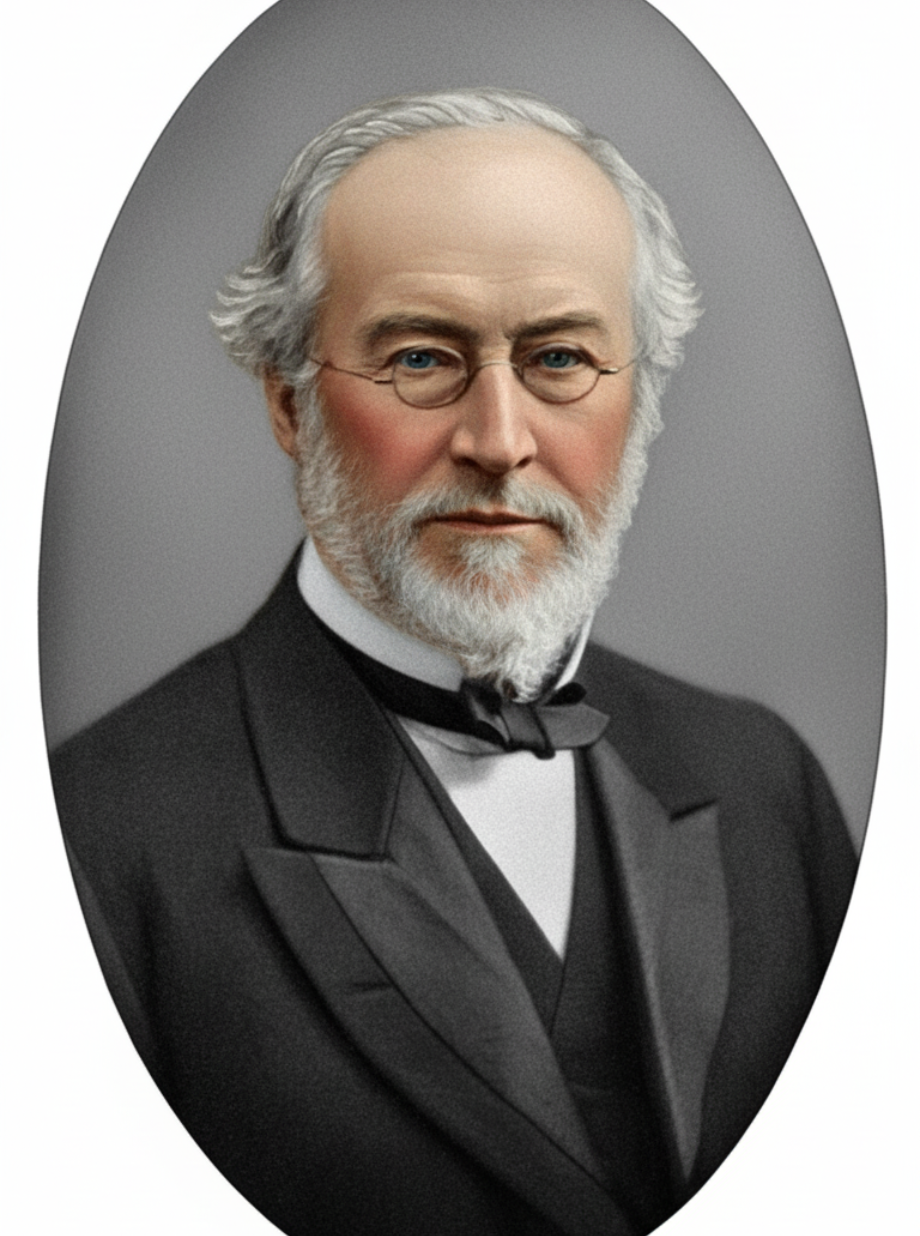
- Years of Life: 1826-1905
Early Life and Quaker Upbringing
James Wright was born in Bristol in 1826, into a home marked by reverence for God and moral uprightness. His parents were devout members of the Society of Friends (Quakers), and their children were brought up carefully “in the nurture and admonition of the Lord.” From infancy James was accustomed to attend the Friends’ Meeting-house, and the principles of truthfulness, simplicity, and integrity that distinguished that body were early impressed upon his mind and character.
Yet, despite this religious upbringing, James Wright came in due course to learn that being a “Friend by birth” could not make him right with God. At the age of fourteen, the Spirit of God worked deeply in his heart, convincing him that he was a sinner by nature and by practice, and that he needed to be born again. He yielded to this divine work, and became, in his own words and experience, “a new creature in Christ Jesus.”
The reality of this new life soon manifested itself in a growing love for the Word of God. In later years he confessed that the long silences characteristic of Friends’ meetings were often spent by him reading chapter after chapter from his New Testament—an early indication of the deep attachment to Scripture that marked his whole life.
Obedience to Scripture and Separation from Quakerism
As he continued prayerfully to study the Bible, the Lord further opened his eyes to the truths of believers’ baptism and the breaking of bread as the Lord’s appointed way for His people to remember Him. With characteristic honesty and obedience, James Wright acted upon what he learned from Scripture, even when it involved personal cost.
He severed his connection with the Society of Friends and was baptised at Tottenham. Shortly afterwards, in 1840, he returned to Bristol and identified himself with the assembly meeting at Bethesda, where George Müller and Henry Craik were then the leading brethren. From that time onward, Bethesda remained the spiritual home and centre of his life’s work.
Business Life and Early Christian Service
On leaving school, James Wright entered business, proving himself diligent, reliable, and conscientious. In 1851, he married Miss Ann Willington Hitchins, who proved to be a devoted and godly companion. Business responsibilities took him again to London in 1856, where he lived in Hackney for several years.
His earliest form of Christian service was Sunday School work, a sphere in which his gifts quickly became evident. His effectiveness as a teacher and organiser led, in 1856, when he was only thirty years of age, to his appointment as Superintendent of the Sunday School at Paragon Road, Hackney.
Call to Ashley Down and Partnership with George Müller
In 1859, George Müller—who had known James Wright from boyhood—wrote to him, asking whether he would become one of his helpers in the work at Ashley Down, Bristol. James Wright accepted the call, and thus began an association that was to last nearly forty-five years, until his death.
During the first eleven years of this period (1859–1870), Mr. Müller described him as “one of the most valuable helpers in the work.” After only one year, it became impressed upon Mr. Müller’s mind that James Wright was the man whom God was preparing to become his successor. For ten years, the matter was quietly and prayerfully laid before God by both men, until they became increasingly assured that this was indeed His will.
Preparation for Succession and Family Sorrows
In February 1870, shortly after the death of his first wife, Mr. Müller formally opened his mind to Mr. Wright regarding succession. True to his humble spirit, James Wright raised many objections, feeling himself unfit for such responsibility. Another difficulty lay in the concern of his devoted wife, who feared the burden the position would entail. After much prayer, she withdrew her objections if her husband believed it to be God’s will.
Not long afterwards, Mrs. Wright was taken Home, so that within a few months both Mr. Müller and Mr. Wright passed through similar bereavements. In August 1871, Mr. Wright asked for the hand of Mr. Müller’s daughter, a proposal that came as a complete surprise to her father. After much exercise of heart, she accepted, and they were married three months later. In May 1872, James Wright formally became associated director with Mr. Müller.
Sole Responsibility and Leadership
Between 1875 and 1892, while George Müller was engaged in preaching tours around the world, James Wright was frequently left in sole charge of the Ashley Down work for many months at a time. His quiet faith, administrative ability, and spiritual discernment proved more than equal to the responsibility.
In 1890, Mrs. Wright fell asleep after a short illness. Mr. Wright later described their eighteen years of married life as a time of “unbroken felicity.” Intensely affectionate by nature, he felt her loss keenly, yet bowed in worshipful submission to the will of God.
After her death, he lived with his nieces, the Misses Withy. When George Müller himself was called Home on March 6, 1898, James Wright found himself the sole director of the work. Following his first report, Dr. Pierson wrote of him that he had shown himself to be “God’s chosen successor in the work, evidently like-minded with the departed director.”
After further waiting upon God, Mr. Wright invited G. Frederick Bergin, whom he had known intimately for twenty-five years, to become associate director. For seven years they laboured together in deep harmony and mutual joy.
Character, Gifts, and Ministry
James Wright was a man of rare spiritual grace. His radiant smile and gentle countenance reflected the peace and joy that ruled in his heart. His demeanour was dignified yet gracious, instantly winning respect and confidence. His humility was as evident as his faith and love.
As a teacher of Scripture, he was widely known and deeply valued. He possessed a strong memory, originality of thought, versatility, a wonderful command of language, and a profound knowledge of the Word of God. Many sinners were tenderly drawn to Christ by his loving appeals, and countless believers had their faith strengthened and their love for the Lord deepened through his ministry.
He was also fond of music, having a rich bass voice, and for many years led the singing at Bethesda. He delighted in joining others around a piano or organ, singing hymn after hymn from the Bristol Tune Book.
Last Illness and Home-Call
James Wright continued in full vigour of body and mind until early 1905, when he was laid aside by a carbuncle that eventually led to blood poisoning. The illness lasted about a month and involved much suffering, which he bore with patience and beautiful submission to God.
Shortly before the end, Mr. Bergin said to him, “Nearing home, beloved brother!” to which Mr. Wright responded with a firm grasp of the hand. At four o’clock on Sunday afternoon, January 29, 1905, he quietly fell asleep in Jesus, at the age of seventy-eight.
Legacy
James Wright’s life was a fragrant testimony of faith, humility, obedience, and love. As the trusted successor of George Müller, he preserved and carried forward the spirit of simple dependence upon God that marked the Ashley Down work. His memory remains precious among the people of God, and his influence continues through the lives he touched and the work he faithfully sustained for the glory of Christ.