
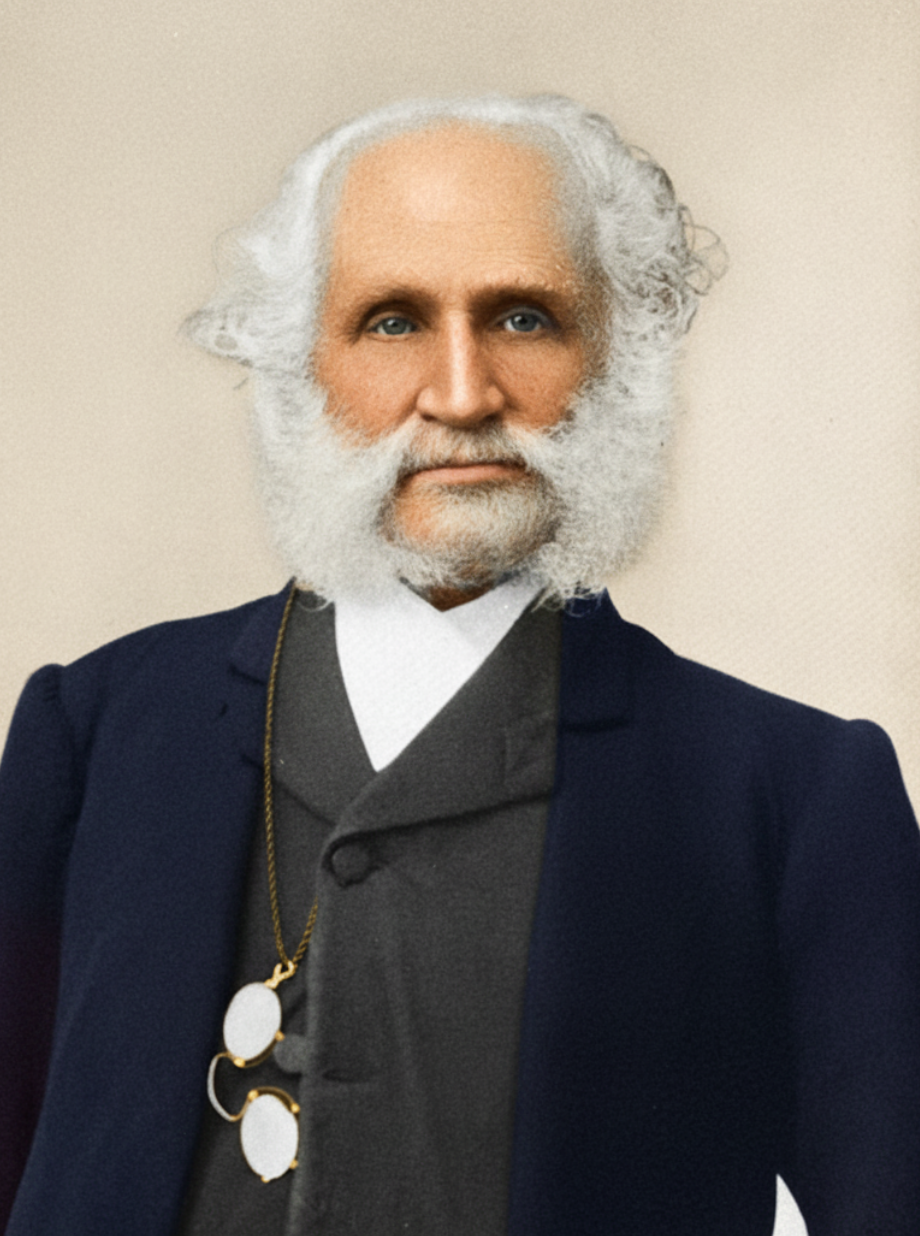
- Years of Life: 1819-1908
Early Life, Education, and Deistic Convictions
Gordon Forlong was born into a distinguished Scottish family and was named after his grandfather, General Gordon of Parkhill, Aberdeenshire. He received a strong education, studying law in Edinburgh, and later practised as an advocate in Aberdeen. By his own frank confession, during these years he was “a very prejudiced young deist,” having imbibed the principal deistical writings of his time.
Yet even in his unconverted days there was a marked concern for moral responsibility. He founded what he called “the Bank of Good Character and Skill,” an initiative designed to help young men of good character obtain trustworthy employment—an early indication of the energetic and reforming spirit that would later be wholly consecrated to Christ.
Conversion in London (1851)
In 1851, Forlong travelled to London, hoping to raise funds for his philanthropic project. It was there that God sovereignly intervened. While calling on Mr. Hitchcock, a Christian merchant of Hitchcock, Williams & Co., St. Paul’s Churchyard, he was met with the searching remark:
“Mr. Forlong, what a pity you are not a Christian!”
When challenged to speak personally of Christ, Forlong found himself unable to do so—an inability that exposed the emptiness of his deism. Mr. Hitchcock then gave him a small book, The Philosophy of the Plan of Salvation. As Forlong read it carefully, one Scripture arrested his soul with irresistible power:
“It is the blood that maketh atonement for the soul” (Leviticus 17:11).
Through this Word, God brought him to saving faith. Like Saul of Tarsus, when it pleased God to reveal His Son in him, “immediately he conferred not with flesh and blood,” but gave himself at once to the proclamation of Christ.
Early Evangelistic Ministry and the Revival Years (1852–1862)
Forlong’s first public testimony was given in 1852, and during the great Revival years (1858–1862) he devoted himself entirely to evangelistic labour throughout Scotland. He worked in close association with Brownlow North and his cousin John Gordon of Parkhill, and the two were often described as “gentlemen evangelists.”
Enormous crowds gathered to hear the Gospel preached with power and conviction in:
-
Glasgow
-
Edinburgh
-
Aberdeen
-
Perth
-
Ayr
-
Dumfries
-
Montrose
-
Annan
-
and many smaller towns
Much blessing followed. Many were converted, and Forlong’s Bible-readings proved especially valuable to the young converts of those awakening days—ministries remembered long after the excitement of revival had passed.
London Ministry and the Talbot Tabernacle
Around 1863–1864, Gordon Forlong began sustained Gospel work in West London. He first preached in the Victoria Hall, Archer Street, Notting Hill, a building then largely used as a theatre. The crowds soon outgrew the space, and later a large iron building was erected, which Forlong named the Talbot Tabernacle.
Prominent Christians such as Lord Congleton, members of the Howard family of Tottenham, and others were associated with this work. From the outset, Forlong insisted on absolute loyalty to Scripture, teaching converts to receive nothing except what could be proved from the Word of God.
A Man of One Book
Perhaps the most striking feature of Gordon Forlong’s life was his unceasing study of the Holy Scriptures. He was truly “a man of one Book.” Speaking of the early years after his conversion, he wrote:
“I sat down to my Bible at 10 a.m., and, except for meals, I never rose till 10 at night. This plan I pursued for years. I had not a single commentary in the house.”
This intense, prayerful immersion in Scripture shaped every aspect of his preaching and teaching.
Preaching Style and Spiritual Character
Forlong’s preaching was striking, fearless, and powerful. To believers it brought comfort and strength; to the unconverted it brought solemn alarm. He was a spiritual warrior, delighting to contend earnestly for the truth of God.
He made no apologies for Scripture, rejected compromise, and held firmly to biblical foundations. Difficulties did not discourage him; rather, he welcomed them as opportunities for God to act. He once remarked that he never felt so much at home as when surrounded by difficulties on every side.
Though a scholar, he utterly rejected Higher Criticism and what later came to be called Modernism, holding the Scriptures to be fully inspired and authoritative. In spirit, he belonged more to the Puritans and Covenanters than to his own generation.
Later Years and Emigration to New Zealand
As his health declined, Gordon Forlong emigrated to New Zealand in 1876. He lived first in Wanganui, later at Rongotea, where he continued to serve Christ as strength permitted.
Though in later years his mental powers weakened, his testimony remained clear, and “the end was peace—perfect peace.” He passed away on 31 August 1908, in his 90th year.
Influence and Legacy
Gordon Forlong was instrumental in the conversion of many who themselves became influential servants of Christ, including:
-
J. R. Caldwell, long-time editor of The Witness
-
Alexander Marshall, author of God’s Way of Salvation
-
C. H. Hinman, a notable New Zealand worker
His written works—Notes on Ephesians, Bible Study: Suggestions and Illustrations, A Few Questions for Deists and Infidels, and others—continue to reflect his clarity, courage, and devotion to Scripture.
Conclusion
Gordon Forlong stands as:
-
a converted deist transformed into a Bible evangelist
-
a fearless defender of Scriptural authority
-
a revival preacher and teacher of rare power
-
a man of uncompromising principle and deep faith
He “stood for the truth of God, and held firmly to all the foundations right to the end.” His life remains a testimony to the power of the Word of God to save, shape, and sustain a servant wholly devoted to Christ.