
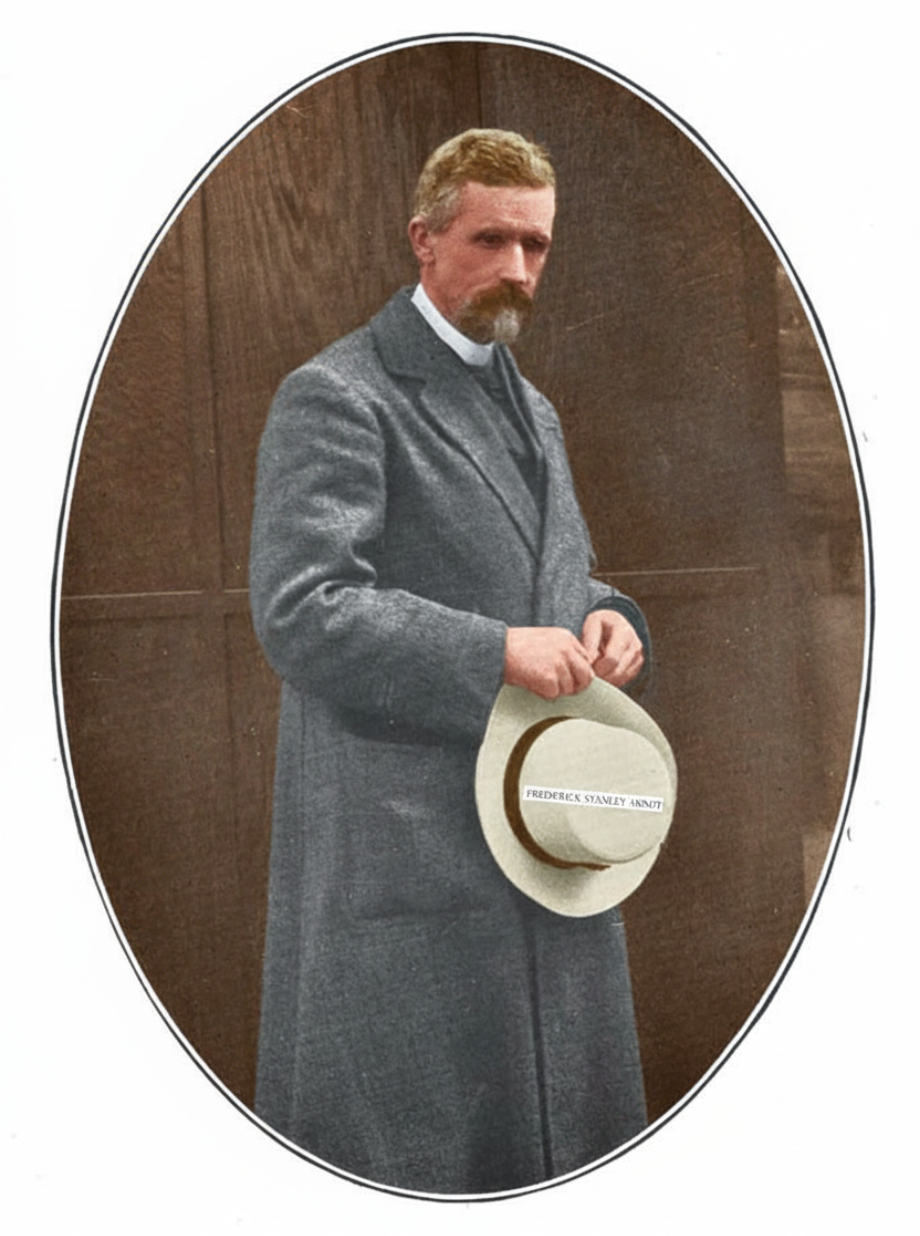
- Years of Life: 1858-1914
Early Life and Call to Africa
Arnot was born in Glasgow on 12 September 1858, though his family soon moved to Hamilton, Scotland. His parents were committed Christians, and faith shaped his upbringing from an early age. A defining moment came in 1864, when six-year-old Fred attended a school prize-giving where Dr. David Livingstone spoke. Livingstone’s vivid descriptions of Africa, his condemnation of the slave trade, and his passion for the gospel left an indelible impression on the young boy. From that day forward, Africa captured his heart.
This interest was strengthened by personal contact with the Livingstone family, who also lived in Hamilton. What began as boyish admiration soon became a settled purpose that guided Arnot’s education, ambitions, and prayers for the rest of his life.
Conversion and Spiritual Foundations
Arnot’s personal conversion came when he was ten years old, through a simple but deeply convicting incident. After stealing plums from a neighbour’s garden, he was called a “thief,” a word that pierced his conscience. Overwhelmed by guilt and fear, he struggled through a sleepless night until, alone in prayer, he remembered John 3:16. The word “whosoever” brought him peace, and he trusted Christ as his Saviour. He later described waking the next morning with a light heart and a burden lifted.
From that point onward, his desire to serve Africa intensified. He believed he now had something of eternal value to offer—the salvation of God.
Preparation for Missionary Life
By the age of fifteen, Arnot was convinced that God had called him to missionary service. With remarkable practical wisdom, he set about preparing himself thoroughly. He learned joinery(joining wooden parts to build stairs, doors, and window frames), blacksmithing, watch repair, and other practical skills that would be invaluable in remote regions. He trained himself to navigate unfamiliar terrain using only a compass, and he regularly engaged in open-air preaching alongside his father. Nothing was wasted; every skill was acquired with Africa in mind.
Journey to Africa
Arnot’s long-cherished dream was realised on 19 July 1881, when he sailed for Africa at the age of twenty-three, accompanied by Donald McLean. Upon arriving in Durban, McLean became seriously ill and had to remain behind. Arnot, undeterred, continued alone.
At that time, rail travel extended only as far as Pietermaritzburg. Beyond that lay thousands of miles of travel by ox-wagon, across drought-stricken plains, rivers, deserts, and politically unstable regions. These hardships only deepened Arnot’s trust in God. He later wrote that God’s promises were not mere words, but certainties—stronger than armies.
Among the Barotse People
After many months of arduous travel, Arnot reached Shoshong on 11 March 1882, where he was warmly received by King Khama, the Christian ruler of the Bamangwato people. After three months there, he continued northward under the protection of Tinka, a Christian headman provided by Khama.
On 19 December 1882, Arnot finally arrived at Lealui, the capital of the Barotse kingdom, ruled by King Lewanika. He spent about eighteen months in the region, teaching children, travelling along the Zambezi, and gradually gaining permission to preach the gospel.
At first, Lewanika strongly opposed Arnot’s message—particularly the idea that slaves and kings stood equal before God. Arnot firmly but respectfully insisted that he must speak God’s words, not his own. Over time, Lewanika’s resistance softened, and Arnot was allowed greater freedom to teach. The people listened carefully, often discussing his words among themselves. One remarked, “Monare’s words pierce the heart.”
Crossing Africa and Work in Garenganze
In 1884, with civil war looming, Arnot was advised to leave Barotseland. On 1 May, he set out for Benguella, on the west coast of Africa, travelling with a Portuguese trader. He arrived in November 1884, having crossed the African continent from east to west—a remarkable feat.
In June 1885, he began another journey, this time to Garenganze (modern Katanga), ruled by King Msidi, who had invited Europeans into his territory. Arnot reached Msidi’s capital on 14 February 1886. From the beginning, he made it clear that he would speak both of God’s love and of human sin and judgment. He refused to dilute his message, even when it risked his safety.
Arnot remained in Garenganze for more than two years, encouraged by signs of spiritual interest and growth.
Marriage and Continued Mission Work
After seven years in Africa, Arnot returned to Britain, where he married Harriet Jane Fisher. In March 1889, they returned together to Africa. Over the next two decades, Arnot established a chain of mission stations between Benguella and Garenganze, helping to lay the foundations for long-term gospel work in Central Africa.
Between 1889 and 1908, recurring illness forced him to spend extended periods in Britain, but he repeatedly returned to Africa whenever his health allowed. He wrote extensively, producing books and letters that brought Africa vividly before Christian readers at home and stirred missionary interest.
Later Years and Death
In 1908, Arnot settled in Johannesburg, using it as a base for further journeys. During this period, he revisited Lewanika and was reunited with Dick, his former servant, who had been baptised in 1887 after confessing faith in Christ.
Despite frequent and severe illness, Arnot continued working for another six years. In May 1914, his life came to an end at the age of 55. Though not long by ordinary standards, his life was extraordinarily full.
Legacy
Frederick Stanley Arnot was one of the great pioneer missionaries of Central Africa in the late nineteenth century—a man whose life combined fearless exploration, deep personal faith, and a lifelong devotion to bringing the Christian gospel into some of the least-known regions of the African continent.
Frederick Stanley Arnot spent 33 years in or for Africa, travelled more than 30,000 miles, crossed the continent multiple times, and opened regions previously untouched by Christian mission. He combined courage, humility, deep faith, and practical wisdom in a way few have equalled.
His writings—Garenganze, From Natal to the Upper Zambesi, and others—remain classic accounts of missionary exploration. More importantly, his life stands as a lasting testimony to wholehearted obedience to Christ and sacrificial love for the peoples of Africa.
Not a long life—but a life richly poured out for God and others.