
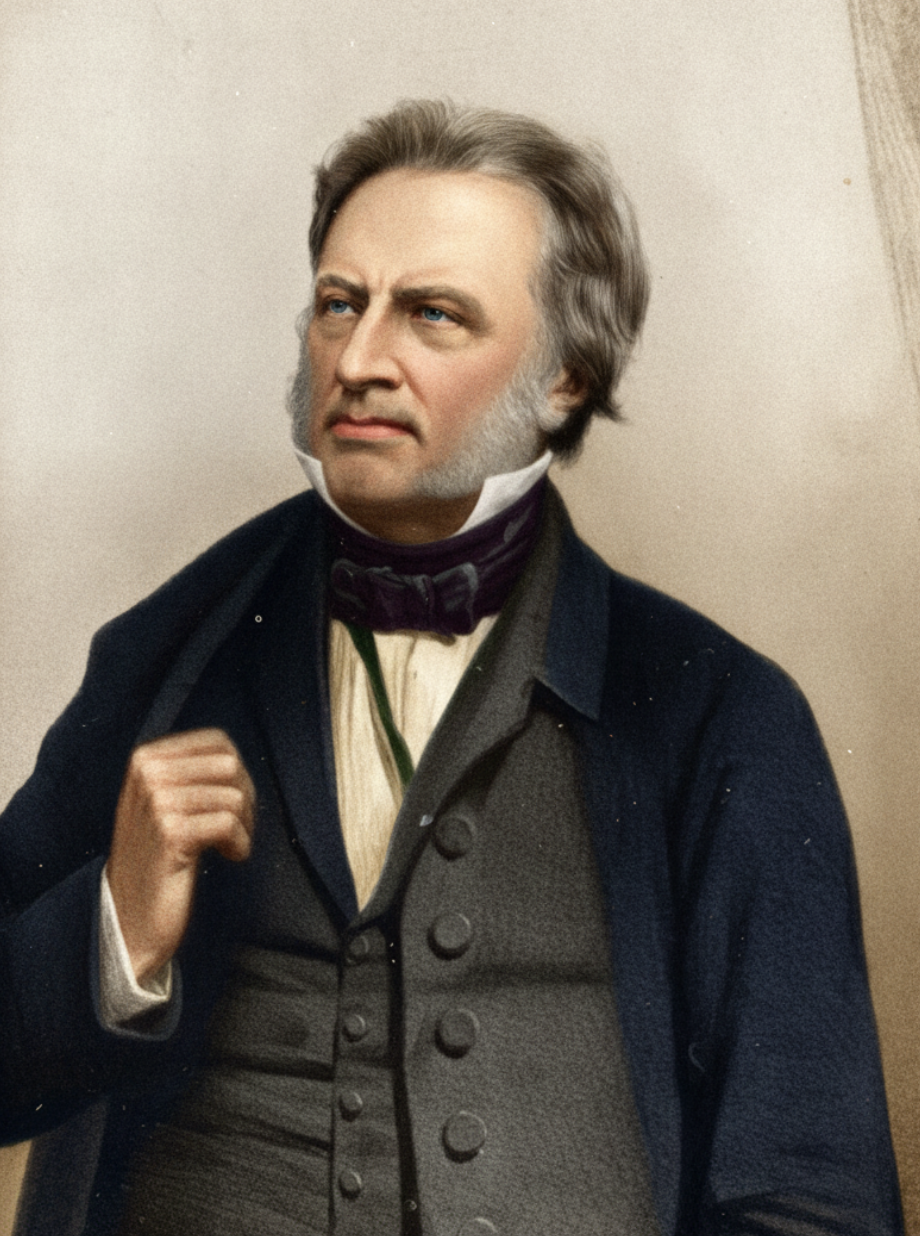
- Years of Life: 1794-1863
Early Life and Naval Formation
Captain William Graeme Rhind, R.N., was born at Gillingham, Kent, on 18 December 1794. His father, William Rhind, R.N., died suddenly when his son was only two months old, leaving him to be reared in a family with strong naval tradition. Many relatives had served at sea, several attaining high rank, and from early childhood Rhind was destined for the Navy.
His name was enrolled as a first-class volunteer at the age of seven, and at twelve he entered active service as a midshipman. Before reaching thirteen, he had already witnessed the horrors of naval warfare, being present at the engagement between the American ship Chesapeake and H.M.S. Leopard, and later in the fierce battle between H.M.S. Macedonian and the American ship United States. The British vessel, heavily outmatched, was devastated; Rhind and the surviving crew were taken prisoner and confined in America for two years.
Later service in the West Indies brought him again close to death when he was struck down with yellow fever. These repeated brushes with mortality left deep impressions upon his mind, though it was not until later that they bore full spiritual fruit.
With the proclamation of peace in 1816–17, Rhind retired from active service as First Lieutenant and, by seniority, later attained the rank of Commander.
Conversion and Call to Christian Service
Settling at Plymouth, Rhind one day entered a place of worship where an aged servant of Christ was preaching the gospel. There he was pointed to “the Lamb of God, which taketh away the sin of the world.” That word entered his soul with power: he found rest in Christ Jesus, and from that moment Christ became “all things” to him.
He often said afterward:
“Whenever I meet a man, I see one for whom I have a message.”
His conversion immediately expressed itself in active service, earnest evangelism, and diligent study of the Scriptures.
Academic Training and Evangelical Zeal
With thoughts of entering the ministry of the Church of England, Rhind entered Sidney Sussex College, Cambridge, in 1822, where the well-known evangelical leader Charles Simeon proved a great help to him. During this period, he befriended Mr. Alexander, a Jewish seeker, took him to Christian worship for the first time, and had the joy of seeing him converted. That same man later became Bishop of Jerusalem.
After three years, Rhind was compelled to leave the University due to failing health. Following a serious surgical operation, he recovered strength and devoted himself entirely to the service of Christ.
Evangelistic Work among Sailors and the Public
Returning to Plymouth, Rhind purchased a small sailing boat, stocked it with Bibles and tracts, and systematically visited ships, boats, and naval vessels in the harbour. He also preached extensively in the open air, a form of service for which he was especially gifted.
He planned:
-
a Bethel for Sailors in Plymouth
-
a Reading Library for invalid seamen in the Royal Navy Hospital
When the Duke of Clarence (later King William IV) visited Plymouth, he asked Rhind—whose father had once been his instructor in navigation—what employment he desired. Rhind replied simply:
“Your Royal Highness, to remain as I am.”
Having put his hand to the plough, no prospect of advancement could induce him to look back.
Ireland, Separation from the Establishment, and Brethren Fellowship
In 1832, Rhind was invited by John Synge to Ireland, where until 1838 he preached the gospel, dispensed medicine, and laboured with blessing on a large estate. During this period, he became acquainted with Lady Powerscourt, at whose home Christians gathered who had separated from the Church of England to meet simply in the Name of the Lord, dependent on the Holy Spirit.
Rhind’s own convictions regarding the nature of ministry and the separated character of the Church deepened. Though a church living was pressed upon him, he declined it, being unable conscientiously to enter the Established ministry.
Returning to England, he lived for nearly four years in Hereford, meeting every Lord’s Day with believers in Bridge Street for the breaking of bread (Acts 20:7). As a teacher he spoke with authority and weight, and as an evangelist he set forth with exceptional clarity that salvation is entirely of grace through faith.
Ross, Wider Ministry, and Personal Character
In 1843, Rhind settled at Ross. A small room was rented in Wilton Road, where at first only ten believers gathered. Soon the space proved inadequate, and over one hundred met together in happy fellowship.
He travelled widely, preaching to large and fashionable audiences at Cheltenham and elsewhere. A tireless personal soul-winner, he would present a tract to nearly everyone he encountered—on rail, coach, or steamboat—calling it “showing his colours at once.”
He frequently taught on the return of the Lord Jesus, increasingly cherishing it as “the blessed hope.” God made him not only a clean vessel, but a large one, filling him with overflowing love. This inner life of communion gave him a radiant joy that led even children to call him “Mr. Gloryface.”
Role among Early Brethren and Final Years
Such was the esteem in which he was held that Rhind was one of the specially selected guides who met at Plymouth in 1845, seeking peace during the serious conflict between Darby and Newton.
He authored many valuable works, including:
-
The Tabernacle in the Wilderness
-
The Six Days of Creation
-
Rome at the Bar of God’s Word
-
China: Its Past History and Future Hopes
-
The Reign of Christ Both Spiritual and Personal
Several passed through multiple editions, reflecting their wide usefulness.
Death and Burial
Captain William Graeme Rhind fell asleep on 17 March 1863 at Weston-under-Penyard, near Ross. His remains were interred in the burial ground attached to the Barton Meeting Room, Hereford, where many hundreds gathered around the grave to honour the memory of a man they loved deeply.
Legacy
William Graeme Rhind is remembered as:
-
a naval officer shaped by war and mercy
-
a fearless evangelist and gifted teacher
-
a pioneer among early Brethren assemblies
-
a man of radiant joy, deep love, and unwavering conviction
His life united courage, doctrine, evangelism, and holiness, leaving a testimony that continues to shine long after his voice has been silenced.