
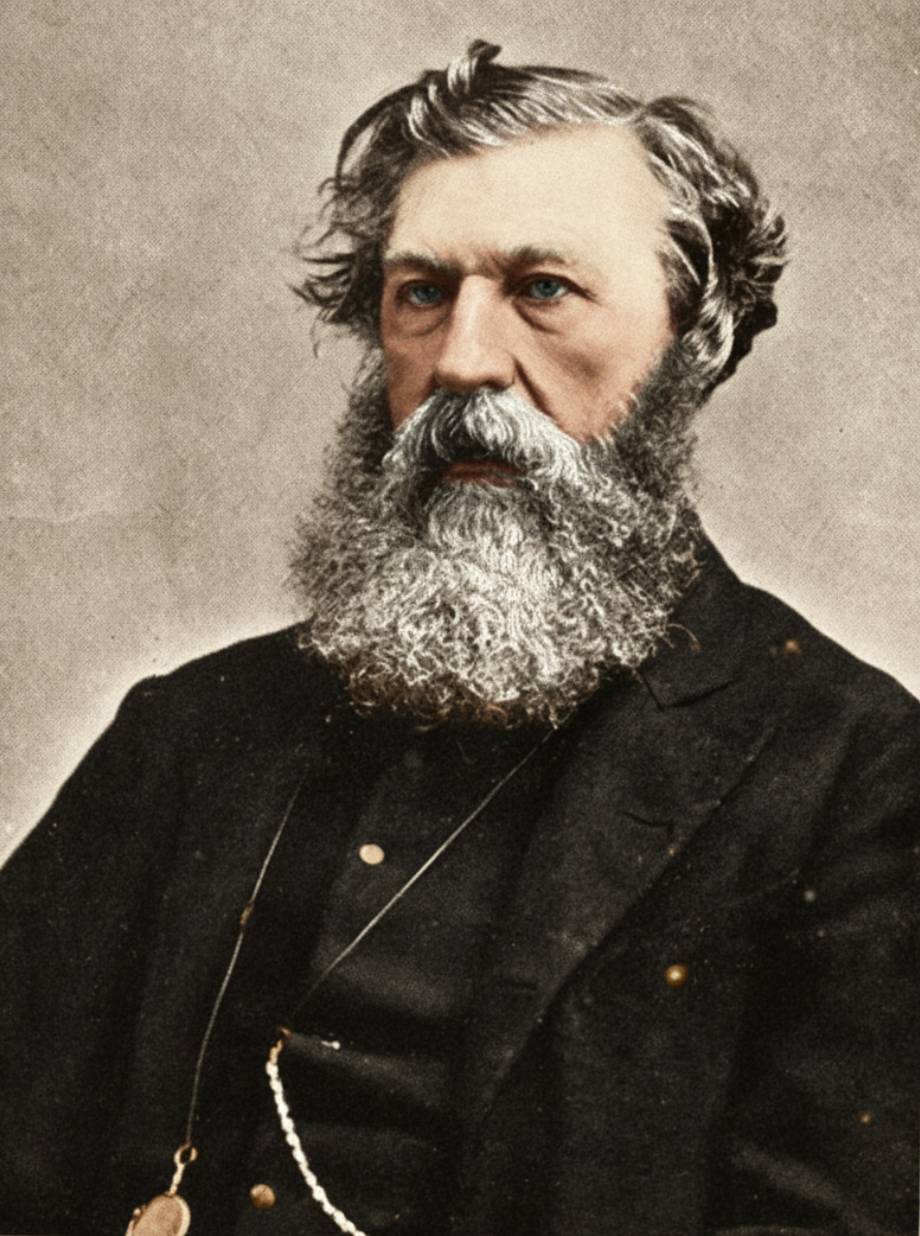
- Years of Life: 1809-1880
Early Life and Military Career
Thomas Hillman Hull was born in 1809 at Marpool Hall, Withycombe Raleigh, near Exmouth, the long-held family estate, his family being Lords of the Manor. He thus belonged to a line of landed gentry, surrounded from birth by privilege, responsibility, and public standing.
As a young man he entered the Indian Army, where he distinguished himself as an able and respected officer. His military career, however, was cut short by ill health, necessitating his return to England. What appeared at first to be a personal disappointment proved, in God’s purpose, to be the turning point of his life. He was soon to exchange the uniform of the empire for that of what Scripture calls “a good soldier of Jesus Christ.”
Conversion in India and Deep Personal Trial
It was during his time in India that Thomas Hull was brought to a saving knowledge of Christ through the ministry of Anthony Norris Groves and his wife, then living at Coonoor, South India. These devoted servants of God opened their own home to Hull and his young wife at a time of profound distress.
Hull’s wife was dying of consumption, and the young officer was broken-hearted. In that place of sorrow, Mr. and Mrs. Groves lovingly ministered the Gospel to them both. Through their quiet, faithful testimony, both husband and wife were converted, and Hull’s wife passed away in perfect peace, resting in Christ.
This season of suffering left a lasting impression on Hull’s character and spirituality. From that point onward, his life was marked by tenderness, humility, and wholehearted devotion to the Lord.
Return to England and Settled Life in Exmouth
Invalided home from India, Thomas Hull returned to England resolved henceforth to live for Christ alone. In later years he married again, his second wife also being a devoted Christian, and together they settled in Exmouth, where Hull’s principal life-work was carried out.
He was a man of wide culture and scholarship, possessing a keen intellect and a gift for clear and persuasive speech. These natural abilities were fully consecrated to the service of the Gospel.
Gospel Ministry and Public Preaching
For many years Thomas Hull preached regularly in the Exeter Road Room, which had been built by his brother for the use of the local assembly of Christians. His ministry there drew large and attentive audiences. It became a familiar sight to see queues of people waiting for the doors to open when Hull was to proclaim “the unsearchable riches of Christ.”
God richly owned his preaching. Many were converted, and many more were led on in the Christian life through his careful, Scriptural teaching. He combined doctrinal depth with warm evangelistic appeal, and his preaching was both instructive and searching.
Open-Air Evangelism and Itinerant Service
Hull was also prominent in open-air preaching, and it could truly be said of him that “the common people heard him gladly.” He possessed the rare ability to address all classes with simplicity, dignity, and spiritual power.
Beyond Exmouth, he was constantly engaged in teaching and exhorting the saints throughout Devon. He attended most of the annual and quarterly meetings in both North and South Devon, ministering the Word wherever opportunity arose.
His evangelistic zeal knew little rest. He was always seeking occasions to speak for Christ:
-
on trains
-
at race courses
-
through tract distribution
-
in personal conversation wherever he went
It would be impossible to number those whom God graciously brought to Christ through his witness.
Spiritual Character
Despite his background, gifts, and wide usefulness, Thomas Hull was marked by deep humility. Those who knew him consistently remarked that he “esteemed others better than himself.” There was nothing aristocratic or distant in his bearing; his gentleness and approachability made him beloved among believers and respected by the unconverted.
His life illustrated the harmony of social position surrendered to Christ and simple brotherly fellowship among the saints.
Final Illness and Home-Call
On Sunday morning, 18 April 1880, at 8 o’clock, Thomas Hillman Hull peacefully fell asleep in Christ after a short illness.
Shortly before this final sickness, he had deeply valued a visit of several days from his longtime friend Robert Cleaver Chapman. Their fellowship was a comfort and encouragement to him as the end drew near.
To the person caring for him in his last days, Hull said words that beautifully summed up his hope:
“I am not dwelling on what Heaven will be like; I am swallowed up with the thought of seeing Jesus.”
Burial and Family Legacy
Several generations of the Hull family lie buried in the ancient churchyard of St. John’s, Withycombe. However, William Hull (Squire Hull) and Thomas Hull were laid to rest in a small enclosed cemetery at Withycombe, given by the former for the use of Christians who met in the Exeter Road Room.
Thomas Hull belonged to a family distinguished not only by social standing but by spiritual fruitfulness. His sister, Miss M. A. Hull, was the author of the well-known hymn:
“There is life for a look at the Crucified One.”
Testimony and Legacy
A well-known evangelist once wrote:
“Whenever I pass Marpool Hall, now occupied and owned by others, I am always reminded of the Hulls and the Haldanes of Scotland. The devotion, self-sacrifice, and whole-heartedness to the cause of Christ of these two aristocratic families were remarkable, and should cause deep searchings of heart.”
Legacy
Thomas Hillman Hull is remembered as:
-
a distinguished officer made a devoted servant of Christ
-
a powerful evangelist and Bible teacher
-
a humble man of great spiritual influence
-
a leader who brought many to Christ and strengthened many more
-
a witness that true greatness lies in whole-hearted devotion to Jesus
His life stands as a testimony that when Christ becomes all, rank, ability, and opportunity are transformed into instruments for eternal good.