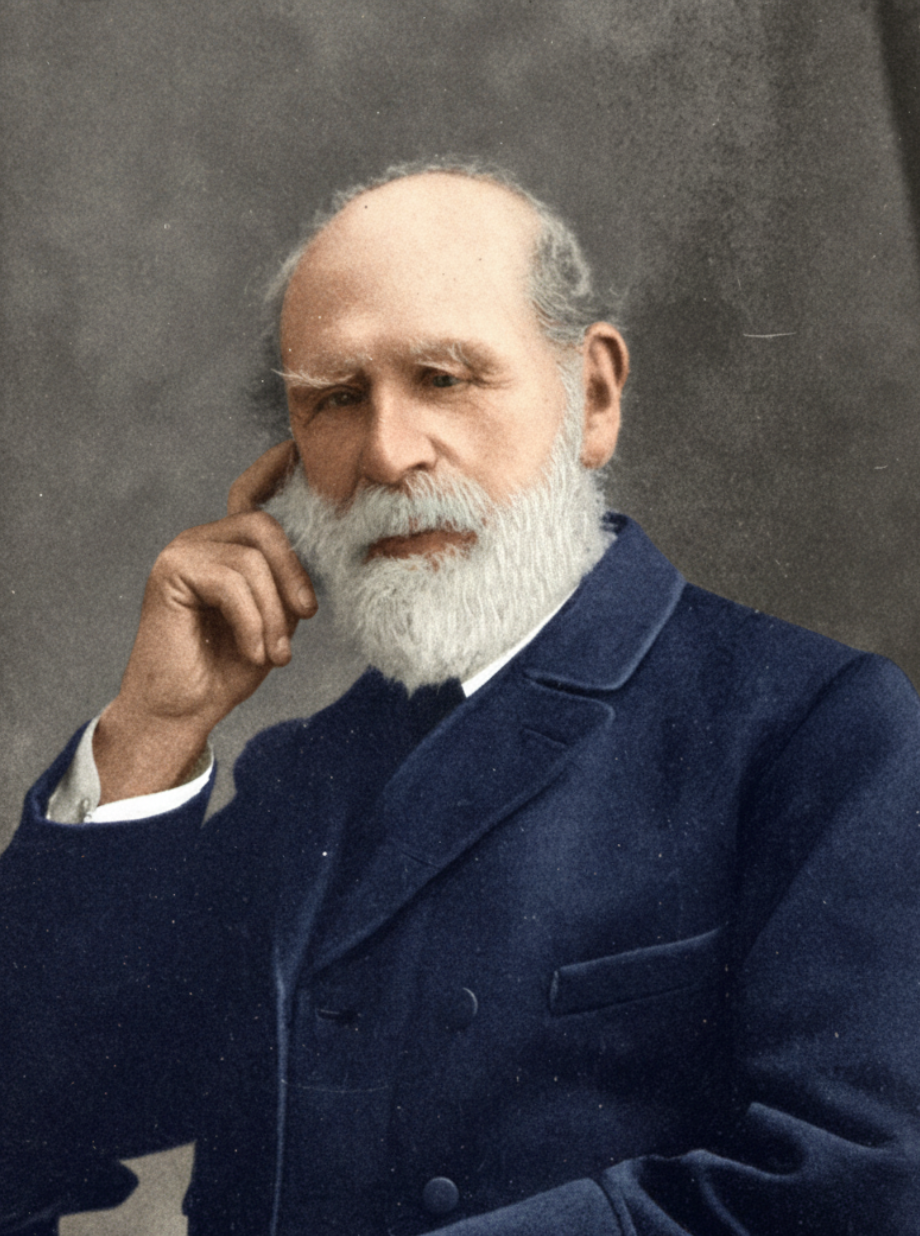
- Years of Life: 1825-1909
Early Life and Spiritual Influences (1825–1844)
Albert Midlane was born on January 23, 1825, in the town of Newport, in the parish of Carisbrooke, Isle of Wight—an island long associated with historic faith and fortitude. He never knew the blessing of a godly father, but he gratefully acknowledged throughout life the deep spiritual influence of a devoted mother and sister, to whom he owed much in his early religious formation.
He began working life as a printer, an occupation that sharpened both his literary instinct and his appreciation for the written word. After three years he left the trade and entered the ironmongery business, first as an assistant and later as a proprietor. For many decades he conducted business faithfully, employing men who remained with him for extraordinary lengths of time—one mourner at his death having served in his firm for over fifty years—testimony to his character and integrity.
As a boy he came under the influence of Thomas Binney, author of “Eternal Light!”, whose preaching and writing likely encouraged Midlane’s early poetic efforts. By 1842, at only seventeen years of age, he had the joy of seeing his first hymn published, written at Carisbrooke. Two years later, in 1844, when only nineteen, his hymn “God Bless Our Sunday School” was sung publicly to the tune of the National Anthem—his first known hymn to be widely used.
A Life Given to Sacred Song
From that point onward, hymn-writing flowed steadily from his pen. Over the course of his life nearly one thousand hymns and poems were composed, covering evangelistic appeal, prayer-meeting supplication, worship, doctrinal truth, and—above all—children’s hymnody.
Among his best-known hymns are:
-
“Revive Thy Work, O Lord”
-
“Sweet the Theme of Jesus’ Love”
-
“Oh, What a Gift the Father Gave”
-
“Himself He Could Not Save”
-
“The Perfect Righteousness of God”
These hymns found their way into revival meetings, prayer gatherings, and assemblies throughout Britain and far beyond.
Yet Albert Midlane’s name is most enduringly associated with children’s hymns, and especially with one hymn that has attained worldwide and timeless fame.
“There’s a Friend for Little Children” (1859)
The hymn “There’s a Friend for little children above the bright blue sky” was written on February 7, 1859, during the great Revival year. After a long and exhausting day in business, Midlane felt an overwhelming desire to write a special message for children. He laboured through the night, finishing the hymn by two o’clock in the morning, but at the cost of severe physical exhaustion. He was later found in a state of collapse and required medical attention. When recalling the event years later, he would simply say, with quiet joy, “But the hymn was completed.”
The hymn was first printed as the concluding article in “Good News for the Young”, edited by C. H. Mackintosh, under the title “Above the Bright Blue Sky.” Its popularity was immediate and extraordinary.
The tune most closely associated with the hymn, “In Memoriam,” was composed in 1875 by Sir John Stainer, under deeply touching circumstances connected with the death of his young son. Thus both words and music were born of love for little children, and their union has proved singularly enduring.
The hymn has since appeared in over 200 hymnbooks, has been translated into more than fifty languages, and is sung across Europe, Africa, Asia, the Americas, and Australasia. It has been said with little exaggeration that it will continue to be sung “while the earth remaineth.”
Recognition and Influence
Albert Midlane’s hymn-writing brought him into contact with many notable figures:
-
Lord Tennyson encouraged his poetic efforts.
-
Dr. Joseph Parker remarked, “I had rather have written ‘There’s a Friend’ than my most eloquent sermon.”
-
C. H. Spurgeon included many of Midlane’s hymns in the Metropolitan Tabernacle hymn book.
-
Queen Victoria graciously accepted volumes of his work, and Prince Albert purchased copies for distribution.
Despite this recognition, Midlane never copyrighted any of his hymns and never received financial gain from their use. After more than fifty years of steady business labour, he was rendered bankrupt for £500 through acting as guarantor for a friend. When his situation became known, Sunday-school friends across the country subscribed generously, enabling him to pay every creditor in full, have his bankruptcy annulled, and secure a modest annuity for his later years.
Ecclesiastical Position and Spiritual Character
In his earlier years Midlane was associated with Exclusive Brethren, but for many decades he identified with the Open Brethren, while maintaining a strong yearning for the true heart-unity of all believers. His poems on “Union” and “No sect on earth but Christians only” reflect this longing.
He was a man of deep humility, gentle spirit, and unwavering devotion to Christ. Hymn-writing for him was not art for art’s sake, but service to God and souls, especially the young.
Final Years and Home-Call (1909)
Albert Midlane lived to see the jubilee of his most famous hymn. In February 1909, three thousand children sang “There’s a Friend for little children” in St. Paul’s Cathedral, and later that month he spoke publicly for the final time at an open-air service in Newport, earnestly appealing to old and young concerning eternal things.
On January 23, 1909, his 84th birthday, one of his final poems appeared in the County Press, bearing clear witness to his readiness for glory:
“Enough! One’s cup is brimming full.
All earthly struggles o’er;
Beneath the shadow of His wings,
In bliss for evermore.”
On February 11, he suffered an apoplectic seizure and quietly passed away in his sleep on February 28, 1909, as the Lord’s Day morning approached.
At his burial in Carisbrooke Cemetery, the congregation sang his own hymns—“Star of the Morning, Rise!”, “One Lasting, Long Amen”, and finally, as children’s voices rose together, “There’s a Friend for little children.” A poignant note was added as a little child was buried nearby while the last verse was sung.
Legacy
Albert Midlane’s legacy is not monuments or wealth, but song—song that has taught children of a loving Saviour, strengthened saints, stirred revivals, and lifted countless hearts heavenward. Long after his voice was silent, he continues to lead myriads in singing of “the Friend of sinners” and the home above the bright blue sky.