
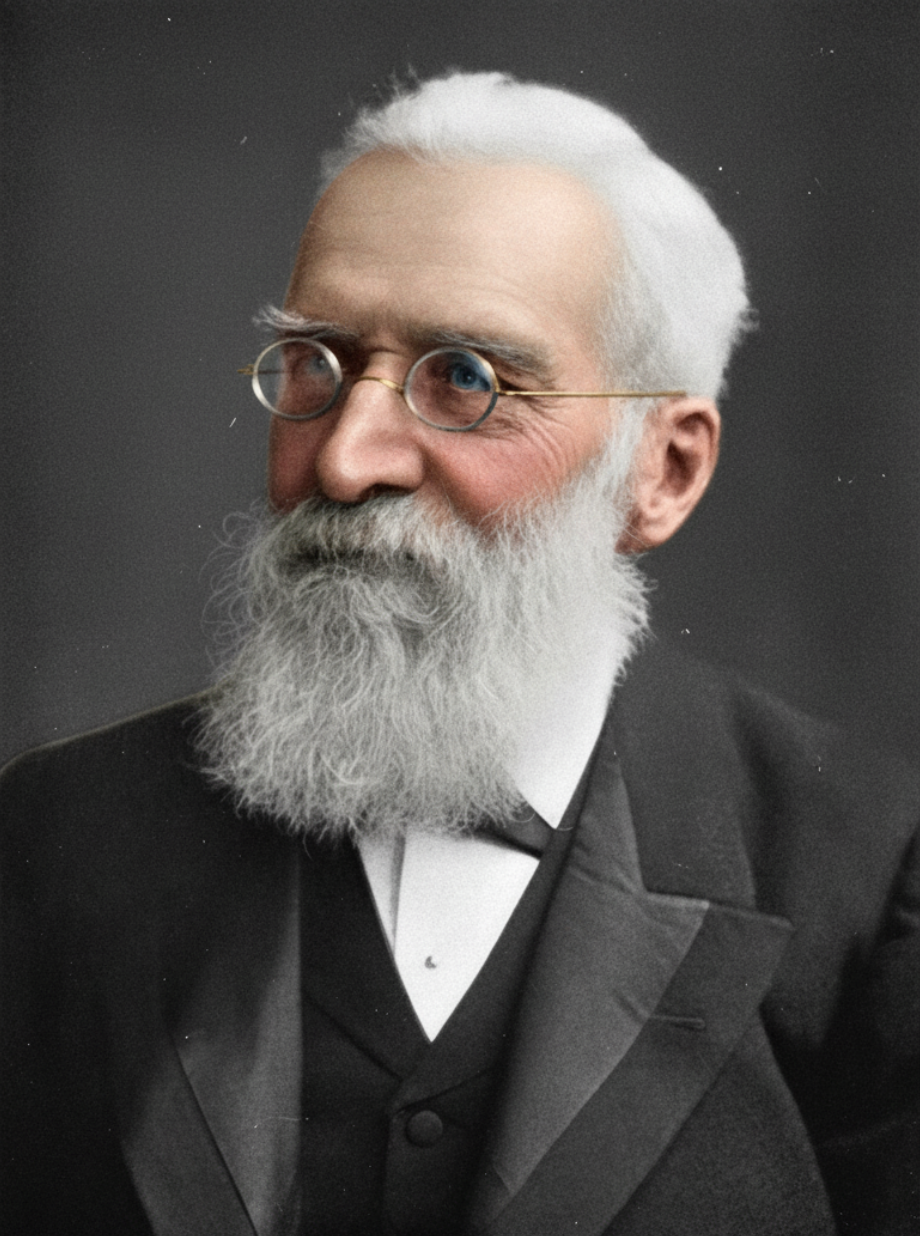
- Years of Life: 1841-1927
Early Life
Henry Frowde was born on 8 February 1841 into a family of Devonshire stock, of which he was quietly proud. He liked to recall that the historian James Anthony Froude came from the same lineage, and he was also related to the writer Mortimer Collins. Though not a scholar by profession, Henry Frowde would become one of the most influential figures in the history of publishing, especially in the worldwide circulation of the Bible.
Early Career and Formation
At just sixteen years of age, Frowde entered the service of the Religious Tract Society, where he gained early experience in religious publishing and distribution. He later became manager of the London Bible Warehouse in Paternoster Row, then the heart of the English publishing trade. These formative years gave him a deep understanding of both the spiritual and commercial sides of Bible publishing.
A turning point came in 1868, when Professor Bartholomew Price, later Master of Pembroke College, Oxford, became Secretary to the Delegates of the Oxford University Press (OUP). Recognising Frowde’s exceptional organisational ability and commercial insight, Price invited him to take charge of the London Office of the Oxford University Press. Frowde assumed this role in February 1874, beginning a remarkable chapter in publishing history.
Transforming Bible Publishing
When Frowde began his work with OUP, there were only 25 Oxford editions of the Bible in circulation. Within twenty years, that number had grown to 78, and it would continue to expand beyond that. His vision, energy, and business insight transformed Oxford into the world’s leading Bible publisher.
The first Oxford Bible he published was a very small, pocket-sized Bible printed in extremely small type, of which 250,000 copies sold almost immediately. This Bible was printed on Oxford India paper, a development that revolutionised not only Bible publishing but also the production of devotional works, poetry, and compact reference books. Inspired by a rare Far Eastern paper first used in 1841 for a handful of experimental Bibles, Frowde encouraged experiments that led to the successful reproduction of this thin yet durable paper—an innovation that book lovers still benefit from today.
Another landmark achievement was the Oxford Bible for Teachers, which by 1876 had taken on a form closely resembling its modern design. This edition proved enormously popular, with many millions of copies sold, and became a standard tool for ministers, teachers, and students of Scripture worldwide.
Frowde also had an exceptional instinct for anticipating public needs. His Finger Prayer Book is a famous example: within weeks of publication, 100,000 copies were sold. Indeed, so many volumes bore his name that it has often been said that no publisher’s name appeared on more books than Henry Frowde’s.
Publishing Feats and National Moments
Henry Frowde was at his best when extraordinary challenges arose. Following changes in the royal succession or royal titles, new editions of the Book of Common Prayer had to be produced at remarkable speed. Frowde organised these operations with calm efficiency, ensuring accuracy and rapid distribution.
He was the central figure in what has been described as “the greatest publishing feat on record”: the release of one million copies of the Revised New Testament within twelve hours, in 1881. Public excitement was immense, with booksellers selling up to 150,000 copies in a single day—a level of enthusiasm for Scripture rarely seen since.
Among all his achievements, Frowde took particular pride in the Caxton Memorial Bible (1877). This remarkable volume was printed at Oxford beginning at 2 a.m., rushed to London for folding, sewing, gilding, and binding in Turkey morocco, and delivered to South Kensington by 2 p.m.—all in time for the 400th anniversary of William Caxton. Prime Minister William Gladstone described it as “the climax and consummation of the art of printing.”
Expansion Beyond Bibles
In 1880, Frowde was appointed Publisher to the University, taking responsibility not only for Bibles but also for the scholarly works of the Clarendon Press. His commercial success with Scripture made it possible for Oxford to undertake ambitious scholarly projects that would have overwhelmed most publishers. Among these was the monumental Oxford English Dictionary, one of the greatest academic publishing enterprises of all time.
Though Frowde was not a scholar or author himself, he was an excellent judge of printing quality, typography, and binding. In recognition of his immense service, the University of Oxford awarded him the honorary degree of Master of Arts (M.A.) in 1897—an honour he valued deeply.
Under his leadership, OUP expanded internationally, opening branches in Edinburgh, Glasgow, New York, and elsewhere. These foundations later enabled his successor, Humphrey Milford, to build the Press into a truly global institution. Popular series such as the Oxford Poets also owe their origin to Frowde’s initiative.
Faith and Personal Life
Personally reserved and not demonstrative in matters of religion, Henry Frowde was throughout his Christian life associated with the group commonly known as the Exclusive Brethren. His faith expressed itself quietly, through diligence, integrity, and lifelong devotion to the dissemination of Scripture.
In 1913, at the age of 72, Frowde retired. Doctors believed he had only a short time to live, but they were mistaken. He spent fourteen further years in retirement at Croydon, physically weakened but mentally alert and deeply interested to the end in the institution to which he had given thirty-nine years of his life.
Death and Legacy
Henry Frowde was called home on 3 March 1927, at the age of 86.
His legacy is immense:
-
He transformed the Oxford University Press into the world’s foremost Bible publisher
-
He revolutionised Bible format, paper, and accessibility
-
He enabled great scholarly works through wise commercial stewardship
-
He exemplified quiet Christian faith expressed through faithful labour
Henry Frowde stands as one of the most significant figures in the history of Christian publishing—a man whose influence has reached hundreds of millions of readers, often without them ever knowing his name.