
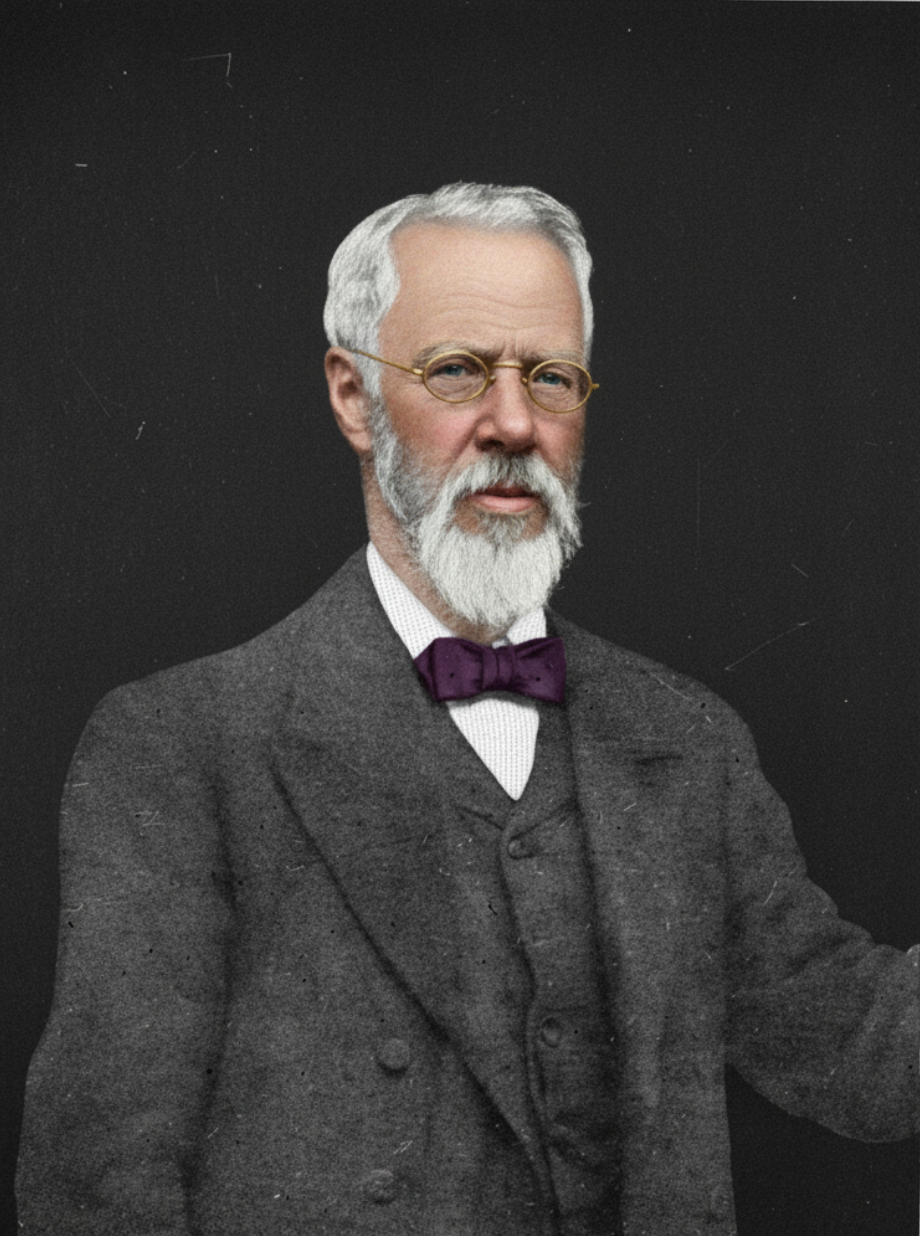
- Years of Life: 1843-1920
Early Life
William Henry Bennet was born at Ashford, Kent, where his father ran a confectionery business. Raised within the Church of England, he was converted to God while still young, and from the outset showed a deep seriousness about spiritual things and a strong desire to serve the Lord.
Early Convictions and Separation from Anglicanism
As a teenager, Bennet briefly pursued a career in railway administration, entering the Railway Clearing House at the age of sixteen. However, he soon returned to Ashford to assist his father. During this time, he became deeply burdened by the spiritual indifference around him and began distributing gospel tracts and holding cottage meetings.
In 1862, when he was just nineteen, Bennet was brought face to face with what he saw as serious errors within the National Church—particularly baptismal regeneration and the declaration of a “sure and certain hope” over those whose lives gave no evidence of faith. Once awakened to these issues, he refused to rest until he had searched the Scriptures thoroughly, asking repeatedly, “What does the Bible actually say?”
The result was decisive. He was baptised as a believer by immersion, withdrew from the Church of England, renounced sectarian connections, and for the next fifty-eight years gathered simply with believers meeting in the Name of the Lord Jesus alone (Matthew 18:20).
At this formative stage he was greatly helped by the ministry of respected teachers such as W. H. Soltau, J. L. Harris, and others who grounded him firmly in Scripture.
Learning the Path of Faith
Shortly after, Bennet moved to Merriott to assist Mr. Gribble in evangelistic work. It was here that he first learned, in practical terms, what it meant to live by faith. Though his parents were concerned about his future support, the Lord repeatedly provided for him in unmistakable ways—through unsolicited gifts given precisely when needed.
These early experiences left a lifelong mark. Bennet never doubted that God was faithful, and to the end of his life he could truthfully say, “My God has supplied all my need.”
Settled Ministry and Family Life
After itinerant service and consultation with trusted elders, Bennet settled in Bow, and later in Yeovil, where he made his permanent home from 1869 onward. In 1871, he married Miss Softley, who proved a devoted and godly companion until her death in 1919, at the age of eighty-nine.
That same year marked the beginning of the Yeovil Conference, which Bennet guided for nearly half a century. These gatherings became widely valued for their scriptural tone, spiritual balance, and pastoral care. Bennet was widely recognised as a true shepherd, marked by gentleness, discernment, and steady faithfulness.
Editorial and Literary Influence
A wider sphere of service opened through the printed page. Bennet became closely associated with The Golden Lamp, which for twenty-one years provided rich and reliable Bible teaching. After its discontinuance in 1890, he joined Dr. John L. Maclean and Henry Groves in the work that developed into Echoes of Service, a publication that stirred missionary interest worldwide.
Though based in Yeovil, Bennet spent part of each week in Bath, quietly and faithfully supporting this growing work for thirty years. His counsel was especially valued because of its calmness, caution, courtesy, and prayerful judgment.
He also contributed extensively to The Witness and Echoes of Service, often writing leading articles under the initials “W.H.B.” His later papers included titles such as “The Holy One of God” and “The Eternal Hallelujahs,” reflecting the Christ-centred focus that characterised his ministry to the end.
Teaching and Character
As a speaker, Bennet was never flamboyant, but he was clear, thoughtful, and deeply scriptural. His expositions—particularly of the Psalms and foundational Christian truths—were valued by those who listened carefully. As a writer, he was precise and persuasive, especially when addressing doctrinal error or warning against the growing ritualism within the State Church.
Above all, his life was marked by consistency. He began well, walked steadily, and finished faithfully. His humility, steadiness, and quiet devotion made him a trusted guide among believers across the British Isles and beyond.
Home-Call and Legacy
William Henry Bennet died at Yeovil on 13 December 1920, in the seventy-eighth year of his age. Those who knew him well could truly say that he had “fought the good fight, kept the faith, and finished his course.”
His legacy lives on through:
-
His faithful Bible teaching
-
His editorial and missionary influence
-
His shepherd-heart for the people of God
-
His example of a life lived simply, steadily, and wholly for Christ
He remains a quiet but enduring example of a servant who trusted God fully, handled Scripture carefully, and finished his race with joy.