
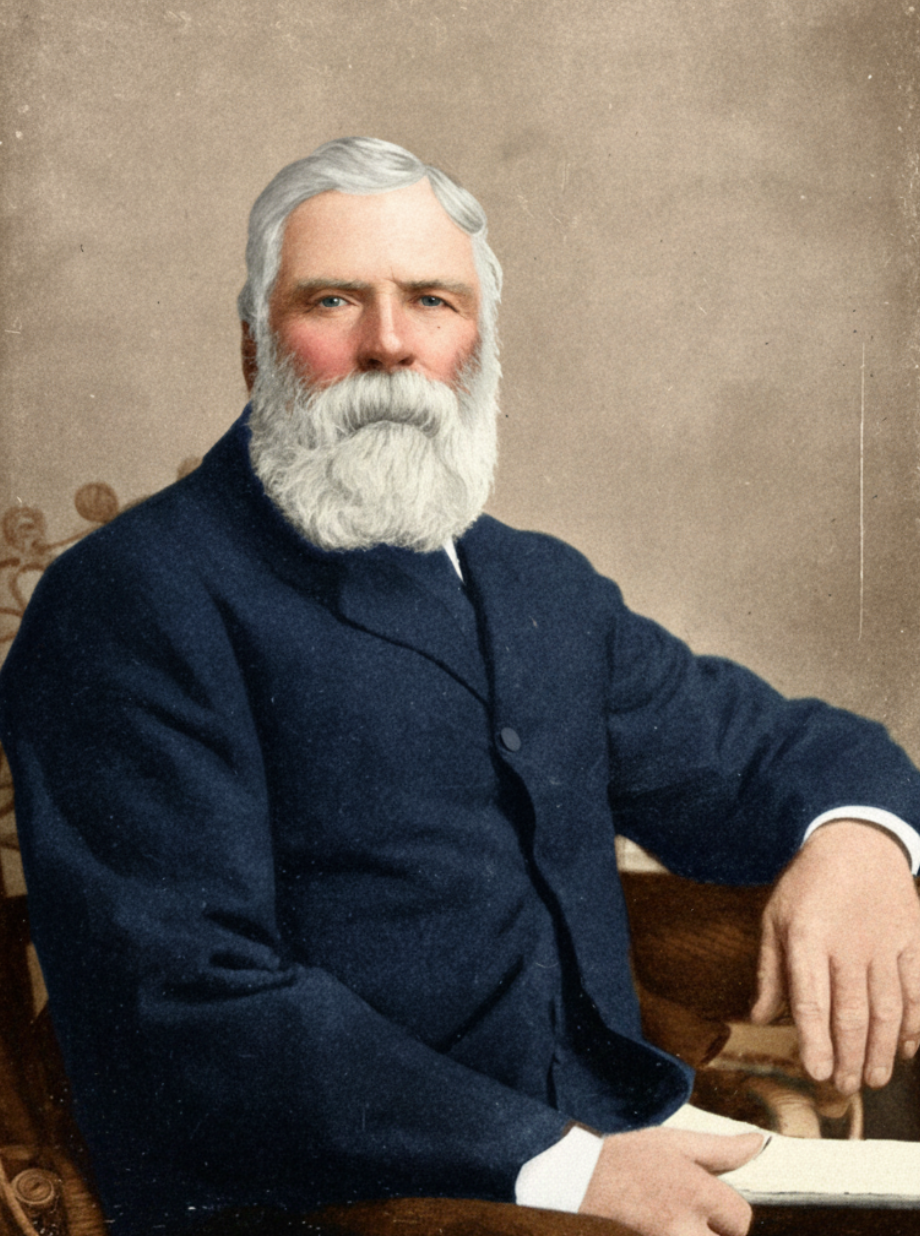
- Years of Life: 1833-1907
Early Life
Harrison Ord was born on March 11, 1833, in Middlesbrough, Yorkshire. As a young man he developed a powerful physique and a strong, independent character, shaped largely through his engineering apprenticeship and years of working alongside practical, hard-headed men in industrial workshops. This background gave him a robust masculinity and credibility that later proved invaluable in Gospel work, especially among working men who instinctively trusted him as “one of their own.”
Conversion
Up until the age of about twenty-four, Ord lived for the present world alone. He was widely respected for his strict morality, reliability, and upright conduct, yet he was unconverted—ambitious, success-driven, and fully absorbed in what he later recognised as the misleading pleasures of life. His goal was professional advancement, and by the mid-1850s he had relocated to London, where engineering opportunities were greater.
At that time, London was electrified by the preaching of Charles Haddon Spurgeon, whose ministry drew enormous crowds. In February 1857, Harrison Ord joined a throng of some 10,000 people making their way to the Surrey Gardens Music Hall to hear Spurgeon preach.
That morning, the message pierced his conscience. Conviction of sin took hold of him and would not let him rest. Some time later, at a prayer meeting where others were earnestly praying for his soul, the Gospel was presented to him clearly and personally—Christ’s finished work, His willingness to save, and God’s love for sinners. In that moment, Ord trusted Christ fully.
The transformation was immediate and unmistakable. Peace replaced anxiety, joy displaced guilt, and assurance settled permanently in his heart. As the hymn “O Happy Day That Fixed My Choice” was sung, Ord’s booming voice rang out so powerfully that it overwhelmed the rest of the congregation. From that day onward, he never again doubted the reality of his salvation.
Call to Gospel Ministry
Ord immediately declared himself openly for Christ. He grew rapidly in his understanding of Scripture and developed a deep, burning love for lost souls. His natural eloquence, commanding presence, and remarkable voice made it clear that God had gifted him as a preacher. Many noted how closely his preaching power resembled that of Spurgeon, whom he regarded as a spiritual father.
Before long, Ord left the engineer’s bench for the evangelist’s platform. During the great revival era of the mid-nineteenth century, he quickly emerged as one of the leading evangelists in Britain. For roughly eighteen years, the United Kingdom became his parish. He preached tirelessly in churches, halls, tents, and open-air meetings, proclaiming “Christ and Him crucified.”
God richly blessed his labours. Many came to faith through his preaching, and as his ministry matured, he increasingly combined evangelism with biblical teaching, strengthening believers as well as winning sinners.
Teaching Ministry and the Tabernacle Model
Never abandoning his engineering skills, Ord put them to spiritual use by constructing a detailed model of the Tabernacle in the wilderness. Using it in lectures, he unfolded the symbolic meaning of its structure, furniture, and sacrifices, showing how they pointed to Christ. These presentations were deeply instructive and left a lasting impression on many who heard him.
Trial, Loss, and a New Field
In 1875, following an extended tent mission and continued meetings at Somerset Hall, Bath, where he lived with his family, Ord’s health collapsed. His once-mighty voice was reduced to a whisper. This physical trial was compounded by deep personal sorrow—the death of his wife, leaving him a widower with four children.
On medical advice, Ord resolved to travel to Australia, hoping that a long sea voyage and change of climate might restore his strength and voice. On February 7, 1876, he sailed for Melbourne, accompanied by his eldest daughter, having been warmly commended to God by friends at Welbeck Hall, London.
The fifteen-week voyage proved restorative. By the time he arrived, his health had improved enough for him to resume preaching on a limited scale.
Evangelistic Work in Australia and New Zealand
Within months, Ord re-entered full Gospel work. Alongside a fellow evangelist, he conducted a three-month mission in Melbourne, where Assembly Hall, Collins Street, was filled night after night. The final meeting overflowed into Wilson’s Circus, with an estimated 4,000–5,000 people present.
The work expanded throughout Victoria, then into Tasmania, with fruitful meetings in Launceston and Hobart. From there, Ord travelled to New Zealand, beginning in Dunedin, where Prince’s Theatre was packed for a month of Sunday evening services. Other cities followed, including Christchurch, Nelson, and Auckland.
In Nelson, the Drill Hall was filled beyond capacity, with crowds standing outside. In Auckland, meetings at the Theatre Royal sparked a work that continued for twenty-five years, long after Ord had moved on. The full spiritual fruit of these labours, as his friends often remarked, would only be revealed in eternity.
Later Years and Home-Call
Ord returned briefly to Britain in 1880–1881, but Australia increasingly became his permanent base. After years of labour in Melbourne, Tasmania, and New Zealand, he settled in Geelong, where he faithfully preached—both indoors and in the open air—as long as strength permitted.
In his final years, his confidence in Christ never wavered. Writing on December 4, 1906, he said:
“Sometimes it seems as though to depart and be with Christ is imminent—with not a care.”
Just four weeks later, on the night of January 1, 1907, Harrison Ord passed peacefully into the presence of the Lord he had trusted, loved, and served for nearly fifty years.
Legacy
Harrison Ord’s life stands as a testimony to:
-
The transforming power of the Gospel
-
The effectiveness of a man fully yielded to Christ
-
Faithful endurance through suffering and loss
-
A ministry that crossed continents and generations
Once a skilled engineer pursuing earthly success, he became a tireless evangelist building for eternity—his voice now silent on earth, but his testimony still speaking through the lives touched by his faithful service.