
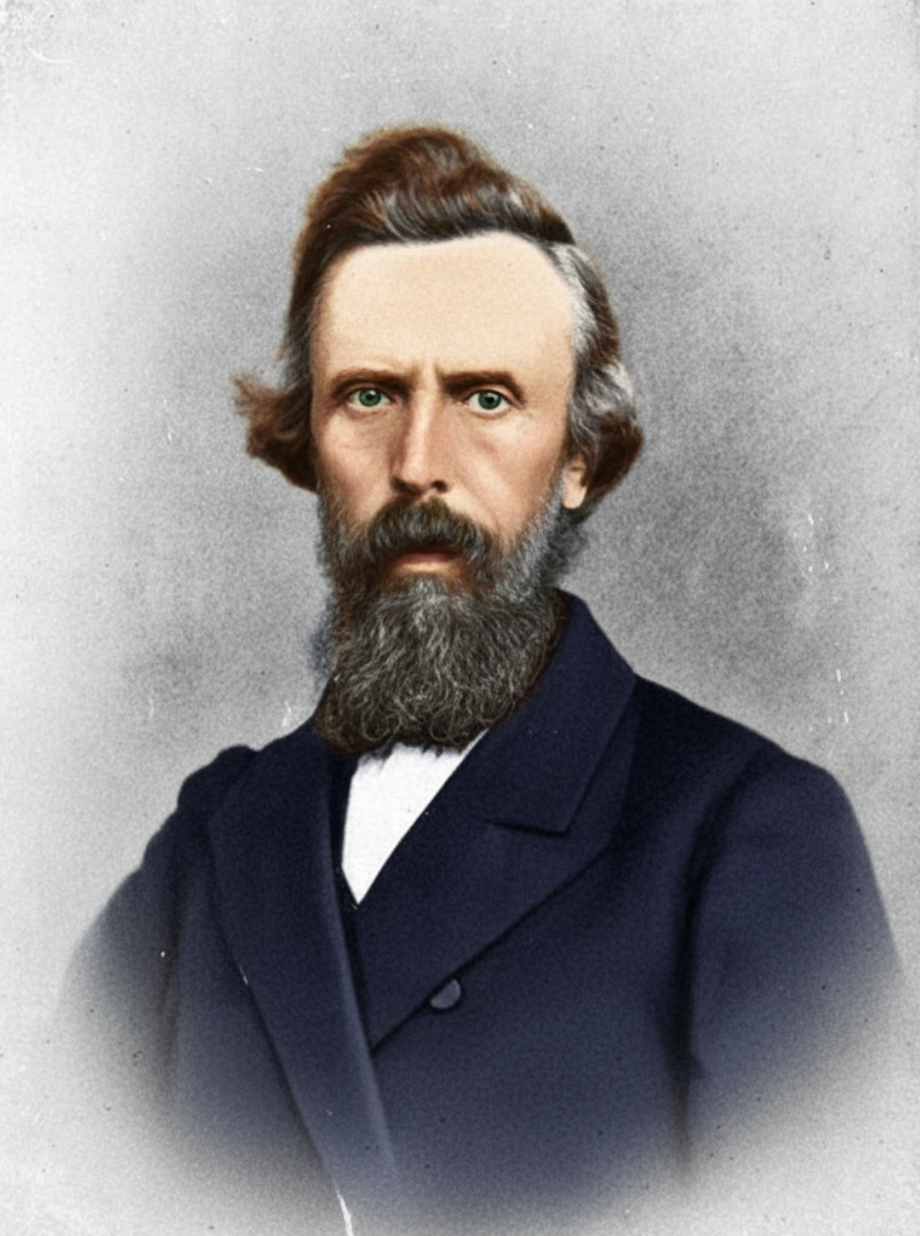
- Years of Life: 1823-1891
Early Life and Education
John Dickie was born in January 1823 in Irvine, a seaport town in Ayrshire, Scotland. He was early bereaved of both parents, an experience that contributed to the formation of a sensitive and reflective character. Delicate in constitution, modest and retiring in disposition, he was nevertheless warm-hearted and deeply affectionate, qualities that later marked both his personal dealings and his writings.
From an early age he showed studious habits and intellectual promise. So diligent was he that, by means of what he earned through teaching, he was able in 1841 to enter Glasgow University. His academic progress, achieved under circumstances of personal fragility and limited means, testified to unusual perseverance and discipline.
Conversion and Early Spiritual Conflicts
During his university years John Dickie passed through the great crisis of his life. Becoming deeply exercised about the state of his soul, and possessing a particularly tender conscience, he felt the burden of sin with painful intensity. Between his nineteenth and twentieth year he was led to accept the Lord Jesus Christ as his all-sufficient Saviour, entering into peace with God.
Yet his conversion did not immediately usher him into uninterrupted rest. His conflicts with indwelling sin and with Satan were long and severe. These early inward struggles, though distressing at the time, profoundly shaped his spiritual understanding, giving depth, reality, and tenderness to all his later ministry. The themes of conflict, consolation, and divine sufficiency which pervade his writings were born in these formative years.
Call to Ministry and Collapse of Health
Having yielded himself unreservedly to God, Mr. Dickie resolved to devote his life to the service of Christ. His earnest desire was to become a minister of the Gospel, and after completing his university studies he entered the Divinity Hall. But toward the close of his first session alarming symptoms of pulmonary consumption appeared. During his second year his health completely failed.
He consulted several of the most eminent physicians in Glasgow, all of whom pronounced his case hopeless. Under these circumstances he returned to Irvine, where for more than two years his condition steadily worsened. His voice failed so entirely that he could communicate only by means of the dumb alphabet. A later consultation with a distinguished London specialist yielded the same hopeless verdict.
Turning his back on the capital, he quietly committed himself to God, saying in effect: If it be His will that I survive, I shall do so; if not, His will be done. Studying his own constitution carefully, he adopted a rigorous system of diet and lived with extreme abstemiousness. This discipline, under God, was the means of prolonging his life for more than forty years beyond what medical opinion had predicted.
Missionary and Pastoral Labours
After some years his health improved sufficiently to allow him to engage in active service. He found a sphere of usefulness as a missionary in Irvine, labouring among the poor and spiritually neglected.
In 1858 he removed to Kilmarnock at the invitation of John Stewart, a well-known Christian gentleman and devoted labourer in the Lord’s vineyard. Here Mr. Dickie remained for about twenty years. Though frequently prostrated by weakness, he persevered patiently in the work of the Lord, counting continually on the sufficiency of divine grace.
He identified himself with a company of believers gathered simply to the Name of the Lord Jesus, meeting in a building erected and maintained by Mr. Stewart. In this fellowship Mr. Dickie ministered regularly in word and doctrine, exercising his gifts with reverence, spirituality, and deep affection for the flock.
His labours among the openly ungodly, the dissipated, the poor, and the sick were richly owned of God. Many were brought to saving faith, and not a few were reclaimed from lives of open sin.
Philip Sharkey and Evangelistic Writing
One of the most remarkable trophies of grace won through his ministry was Philip Sharkey, a profane and drunken blacksmith who had long been a terror to his neighbours. Mr. Dickie sought him out with patient, prayerful persistence, and had the joy of leading him to trust in the Saviour. Sharkey’s subsequent transformed life and triumphant death bore unmistakable witness to the reality of his conversion.
Mr. Dickie wrote an account of this case under the title Philip Sharkey, the Kilmarnock Blacksmith, which achieved extraordinary circulation. One gentleman alone purchased 100,000 copies for distribution. This success opened a wide door for his pen.
He went on to write numerous tracts and booklets, including The Devil’s Cradle, Stewardship, Divine Compensations, Christian Thoroughness, and many others, each marked by spiritual insight, vivid illustration, and experimental truth. The circulation of these writings reached many thousands. He also contributed regularly to religious periodicals, notably The Family Treasury, and wrote poems and hymns expressive of deep spiritual experience.
Years of Confinement and “The Cream of Life”
In 1878 his health declined so severely that he returned to Irvine to live with his sister and her husband, Provost Watt. For a few years he was still able, though feebly, to serve the Lord; but in 1882 his remaining strength entirely failed. For the last eight years of his life he was confined wholly to his room, leaving it only once, briefly, in the summer of 1890.
These years were marked by intense suffering: constant sickness, severe pain, extreme weakness, sleeplessness, and nervous irritability. Yet during this prolonged confinement his ministry greatly widened rather than diminished. From his sick-room flowed letters of spiritual counsel, consolation, and testimony, which were later published as Words of Faith, Hope, and Love, from the Chamber of a Dying Saint, and More Words of Faith, Hope, and Love. These volumes brought unspeakable comfort to multitudes and remain enduring monuments of triumphant grace.
So rich was his experience of Christ during this period that he afterwards said these years were “the cream of his whole life.”
Home-Call and Legacy
On 18 January 1891, John Dickie gently fell asleep in Jesus. When the pangs of death were upon him and his eyes were closed, he was asked if he was sleeping. He replied quietly, “Just musing on the sufferings of the Cross.” Conscious to the last, he passed from a place of suffering into the presence of his Lord.
His mortal remains were laid to rest in Irvine Cemetery, in the presence of many friends.
Assessment
John Dickie’s life stands as a luminous testimony to the sufficiency of divine grace in prolonged weakness. Denied the active ministry he once desired, he became instead one of the most fruitful Christian writers of his generation. His pen, dipped in suffering yet guided by faith, hope, and love, spoke to thousands whom his voice could never have reached.
Though physically confined, he ranged widely in spiritual influence; though long acquainted with pain, he radiated consolation; and though weak in body, he was strong in the Lord. Truly, “He being dead yet speaketh.”