
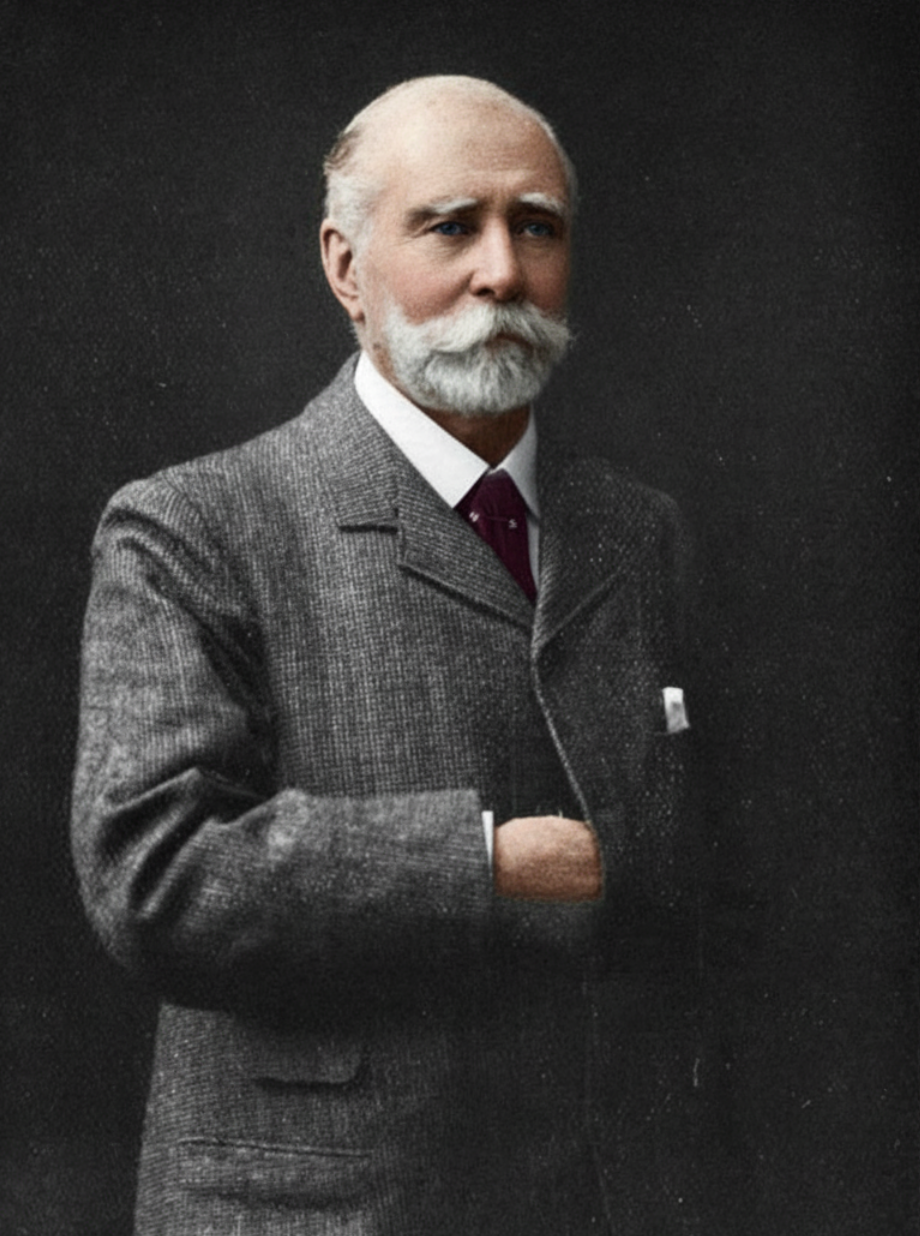
- Years of Life: 1839-1917
Early Life and Religious Upbringing
John R. Caldwell was born in Dublin on 26th May, 1839. When he was five years old, his parents removed to Glasgow, where he was brought up in an atmosphere of moral earnestness and evangelical religion. His father was a leading figure in the Independent (Congregational) Church, and from childhood John was trained in what Scripture calls “the nurture and admonition of the Lord.”
In these surroundings, he naturally grew into a respectable and religious life. After being interviewed by two deacons—who inquired whether he believed the Bible and the Lord Jesus—he was received into church fellowship. He taught in the Sunday School, joined the Young Men’s Christian Association, and was widely regarded as a Christian. Yet, as he later discovered, this outward standing lacked inward life.
Conversion During the Revival Era (1860)
The year 1860 proved decisive. During that time, Gordon Forlong, a well-known gentleman evangelist, conducted meetings at Ewing Place Church in Glasgow. Under the searching ministry of the Word, Caldwell became deeply exercised about his spiritual condition. At the close of one meeting he remained among the anxious seekers, and heard the words of John 5:24 proclaimed with clarity and power:
“He that heareth My word, and believeth on Him that sent Me, hath everlasting life, and shall not come into condemnation, but is passed from death unto life.”
He later testified: “I heard, I believed, and I had everlasting life.” From that moment the Bible became to him a new Book, opened by the Spirit of God, and henceforth his constant and beloved companion.
Separation from Sectarianism and Scriptural Gathering
The Revival of 1859 had stirred Glasgow deeply. Lay preaching became common, ecclesiastical restraints were loosening, and many believers were seeking freer ground for Gospel testimony. In Ewing Place Church, the newly awakened spiritual life overflowed normal channels. Independent Gospel services were begun—but this proved unacceptable to the minister, who insisted they be stopped.
At this critical moment, John Caldwell and his father—both increasingly burdened by the bondage of sectarianism—came into contact with godly men who were emerging from Scotch Baptist associations into what would later be called Brethren principles, though better described, as Caldwell himself noted, as “the ways that be in Christ” (1 Corinthians 4:17).
Bible readings were held in the Caldwell home. Doctrines were searched out directly from Scripture, and neglected truths were examined. The result was deep conviction and obedience: John R. Caldwell and his friend and business partner George Young were baptised as believers by immersion.
After a difficult transition period, Caldwell severed his connection with Congregationalism and committed himself for life to meeting simply according to Scripture, gathered to the Name of the Lord alone. He found there true fellowship—souls to whom the Word was precious and the Name of Jesus sweet.
Business Life and Christian Consistency
Caldwell became head of Caldwell, Young & Co., Silk Merchants, conducting an extensive and successful business. Yet prosperity never diverted him from spiritual priorities. His life presented no dramatic contrast between commerce and Christianity; rather, it showed the beauty of steadfast faithfulness, day by day, year after year.
Though outwardly quiet and orderly, his life was richly fruitful. Indeed, to recount the full range of his service would require a volume.
Ministry of the Word
John R. Caldwell’s ministry was known and valued worldwide. Thousands of the Lord’s people treasured his teaching.
-
In the morning meeting, his contributions were brief, Christ-centred, worshipful, and full of spiritual fragrance.
-
In Sunday School, Gospel meetings, and even street preaching, his words were quietly but reverently received.
-
His special strength lay in systematic exposition of Scripture—whether through entire books (notably Leviticus, Corinthians, Thessalonians, and Hebrews) or through thematic series on the Offerings, Old Testament types, Christian duties, and God’s purposes for Israel.
He prepared carefully, using only small slips of paper marked with headings and abundant Scripture references. He kept no detailed records of his addresses and felt entirely free to repeat messages when appropriate. Among his frequently repeated and much-loved themes were “The Red Heifer,” “The Kinsman-Redeemer,” “God Our Father,” “The Love of God,” “The Church,” and “The Lord’s Coming.”
Literary Work and Writings
Caldwell’s pen was scarcely less fruitful than his voice. His early book “Things to Come”—written while still young in faith—remains remarkably clear and relevant, and was listed by Dr. R. A. Torrey among the best books on prophetic truth.
Other major works include:
-
God’s Chosen People
-
Shadows of Christ in the Old Testament
-
Christ in the Levitical Offerings
-
Because Ye Belong to Christ
-
From the Cross to the Kingdom
-
The Earthly Relationships of the Heavenly Family
His two-volume exposition of 1 Corinthians, delivered originally to congregations of over 600, was later published as “The Charter of the Church” and remains a standard work on Church truth.
In addition, he produced countless pamphlets, tracts, and magazine articles, all marked by careful preparation, doctrinal balance, moderation of tone, and spiritual aim.
Editor, Counsellor, and Shepherd of Souls
From 1876 to 1914, Caldwell edited The Witness, maintaining a steady and Scriptural testimony during years of doctrinal unrest. His counsel was sought by brethren of every background across the world. Whether spoken quietly or written plainly, his advice was thoughtful, prayerful, and wise. The full measure of this service will only be known at the Judgment Seat of Christ.
Doctrinal Position and Fellowship
Caldwell was unwavering in adherence to sound doctrine. He resisted Higher Criticism, modern theological novelty, and irreverent handling of Scripture. He firmly upheld:
-
The verbal and plenary inspiration of Scripture
-
The essential Deity and perfect humanity of Christ
-
The sufficiency of the atonement
-
The present possession of eternal life
-
The priesthood of all believers
-
Believers’ baptism by immersion
-
The weekly breaking of bread
-
Separation from the world
-
Gathering apart from sectarian names
-
The pre-millennial coming of the Lord
-
The eternal destiny of both saved and lost
Regarding fellowship, he acknowledged an earlier period of excessive narrowness, but consistently advocated the reception of all who were born again, sound in fundamental doctrine, and godly in walk, following the practice of early Brethren.
Personal Character and Liberality
His liberality was great but deliberately hidden, in obedience to Scripture. An earnest advocate of systematic giving, his generosity far exceeded what many would imagine. His humility, consistency, and quiet godliness endeared him to all who knew him.
Closing Years and Home-Call
Signs of failing strength appeared as early as 1905. That year, fifty-two brethren gathered to express love and gratitude for his ministry, fearing they might not meet again. As his health declined, he rested increasingly in childlike trust upon God.
Without complaint, through months of weakness and pain, he waited until, on Lord’s Day morning, 14th January, 1917, he quietly fell asleep in Christ—awaiting the Resurrection morning, when he would awake in His likeness.
Legacy
John R. Caldwell stands among the most balanced, careful, and spiritually fruitful teachers of his generation. A man of Scripture, prayer, generosity, and pastoral wisdom, he left behind a legacy not of personality or party, but of truth faithfully taught and Christ lovingly exalted. His works still speak, and his influence continues wherever saints value the Word of God and the unity of the Spirit.