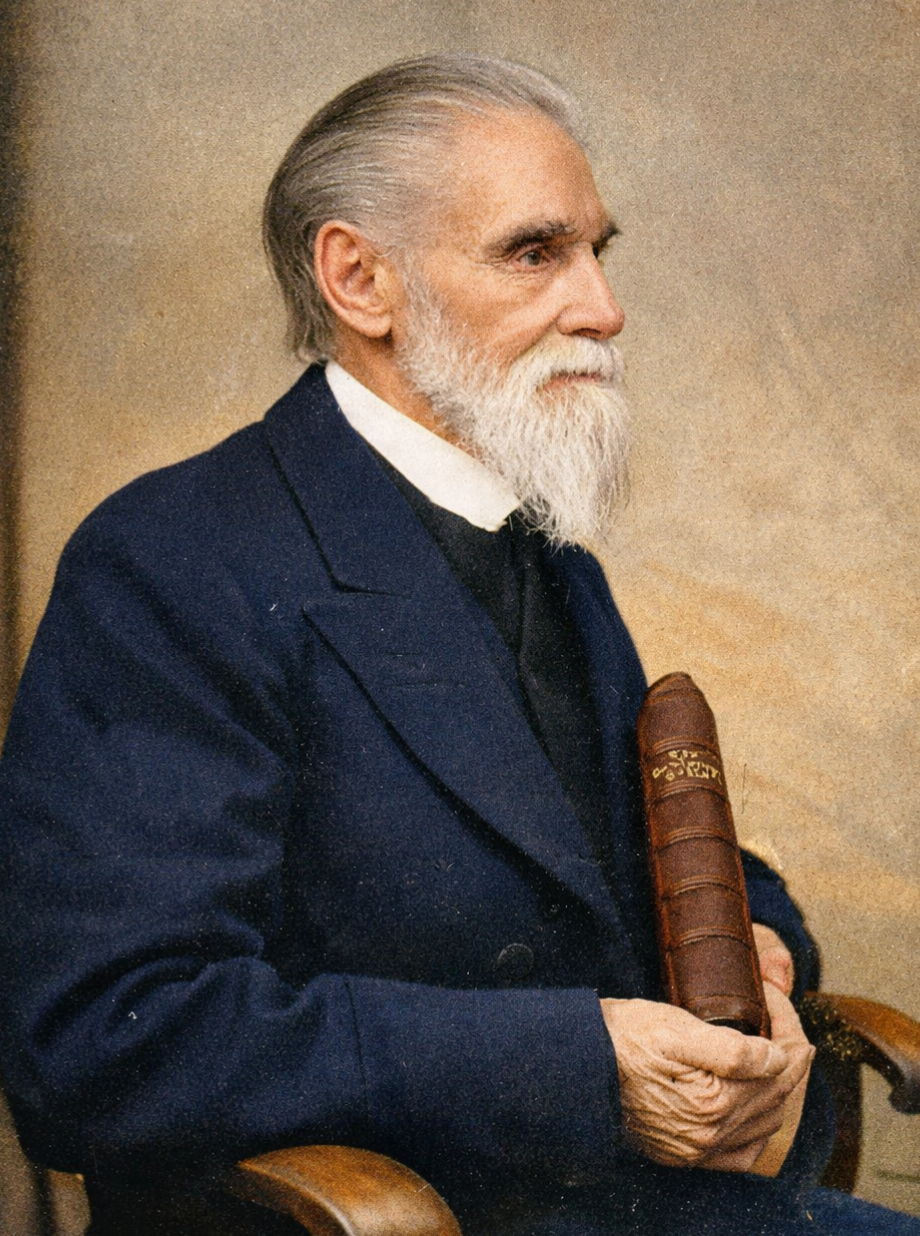
- Years of Life: 1810-1901
Early Life and Spiritual Formation
Thomas Newberry was deeply conscious throughout his life of the mercy of God in granting him a Christian mother and a godly elder sister, through whose instruction and example he was, like Timothy, taught the Holy Scriptures from childhood. From these early years the Word of God became familiar to him, and it pleased God in due time to reveal His Son in him as Saviour and Lord, so that he knew the reality of being “born again” by the incorruptible Word of God (John 3:3; 1 Peter 1:23).
His Christian life thus began with a profound love for, reverence toward, and confidence in the Scriptures, which remained his food, delight, and authority throughout more than sixty years of active service. The Bible was not merely a theological textbook to him, but “the joy and rejoicing of his heart” (Jer. 15:16).
Devotion to the Study of Scripture
In the earlier years of his Christian experience, Mr. Newberry read the Scriptures primarily for personal comfort and instruction. About sixty-one years before his death, however, he began an intensive and systematic study of the Bible in the original Hebrew and Greek. This pursuit continued for twenty-five years with extraordinary diligence.
The fruit of these labours was one of the great achievements of his life—The Englishman’s Bible, later known widely as the Newberry Bible. This monumental work was designed to place within reach of ordinary English readers the treasures of the original Scriptures, enabling them to observe variations of tense, preposition, and meaning with remarkable clarity. Scholars of high standing commended the work for the accuracy, restraint, and reliability of its marginal notes.
Mr. Newberry regarded this Bible not as a scholarly curiosity, but as a practical tool for the saints, helping them to understand the inspired Word more fully and reverently.
Separation on Scriptural Grounds and Assembly Testimony
Careful Scripture study inevitably led Mr. Newberry into association with the great spiritual movement of the early nineteenth century, when many devoted Christians were led by the Spirit of God to re-examine their ecclesiastical positions in the light of Scripture.
Between 1828 and 1830, searching of heart became widespread. Godly men met together, as in Malachi’s day, to speak often one to another concerning His Name (Mal. 3:16). They became convinced that much prevailing teaching and practice was not in harmony with Scripture; that customs were often governed by expediency rather than obedience; and that apostolic principles plainly taught in 1 Corinthians and elsewhere were being neglected.
Unable to preach, teach, or practise all that they found written in the Word of God while remaining in systems that violated it, they separated from such associations in obedience to passages such as 2 Corinthians 6:14–18 and Revelation 18:4. They sought instead to gather simply on Scriptural ground, owning the absolute authority of Scripture, rejecting human creeds and regulations, and allowing liberty for the exercise of spiritual gifts according to Ephesians 4, Romans 12, and 1 Corinthians 12–14.
Mr. Newberry fully identified himself with these principles, maintaining that the Word of God alone must decide all matters of doctrine and practice, and that its authority was binding upon all who professed to walk in fellowship.
Ministry of Teaching and Writing
Thomas Newberry became widely known as a teacher of Scripture of exceptional accuracy and depth. His lectures and writings on the Tabernacle, the Temple, the Offerings, and the Types of Leviticus were used of God to instruct and edify thousands of believers.
One of the most remarkable expressions of his scholarship was the construction of a detailed model of Solomon’s Temple, unique in design and workmanship. This model was the result of painstaking research in the original Scriptures, aiming to convey to modern minds something of the splendour and significance of the divinely given patterns revealed to Moses and David. His writings on the Temples of Solomon and Ezekiel and on the Tabernacle remain enduring memorials of his labour.
In addition to these, he authored valuable works on Revelation, the Parables of the Lord Jesus, the Song of Solomon, prophetic themes, and the perfections and inspiration of Scripture. His writings were marked not by speculation, but by reverence, balance, and fidelity to the text.
Travels, Correspondence, and Pastoral Care
For many years Mr. Newberry travelled extensively throughout the British Isles, expounding the Scriptures, delivering lectures on his tabernacle and temple studies, and ministering to assemblies of believers. He also maintained an extensive correspondence with Bible students in many parts of the world, always seeking to be a helper of the saints.
He contributed regularly to The Witness and other Christian periodicals, and his quiet, patient manner won the confidence of many. Though firm in conviction, he was not contentious in spirit, and his ministry reflected a deep personal submission to the authority of the Word of God.
Closing Years and Home-Call
In his later years Mr. Newberry continued his labours as strength permitted, retaining mental clarity and spiritual warmth to the end. He fell asleep in Jesus at Weston-super-Mare on 16 January 1901, in his ninetieth year.
His published works—including The Englishman’s Bible, Notes on the Tabernacle, Notes on the Temple, The Parables of Our Lord, The Temples of Solomon and Ezekiel, Solar Light, and many others—continue to bless believers long after his departure.
Testimony to the Inspiration of Scripture
In old age, looking back over a lifetime devoted to the study of God’s Word, Thomas Newberry wrote this striking testimony:
“As the result of a careful examination of the entire Scriptures in the originals, noticing and marking where necessary every variation of tense, preposition, and the signification of words, the impression left upon my mind is this—not the difficulty of believing the entire inspiration of the Bible, but the impossibility of doubting it.”
This conviction sums up his life: a reverent scholar, a faithful servant, and a man wholly governed by the Word of God.