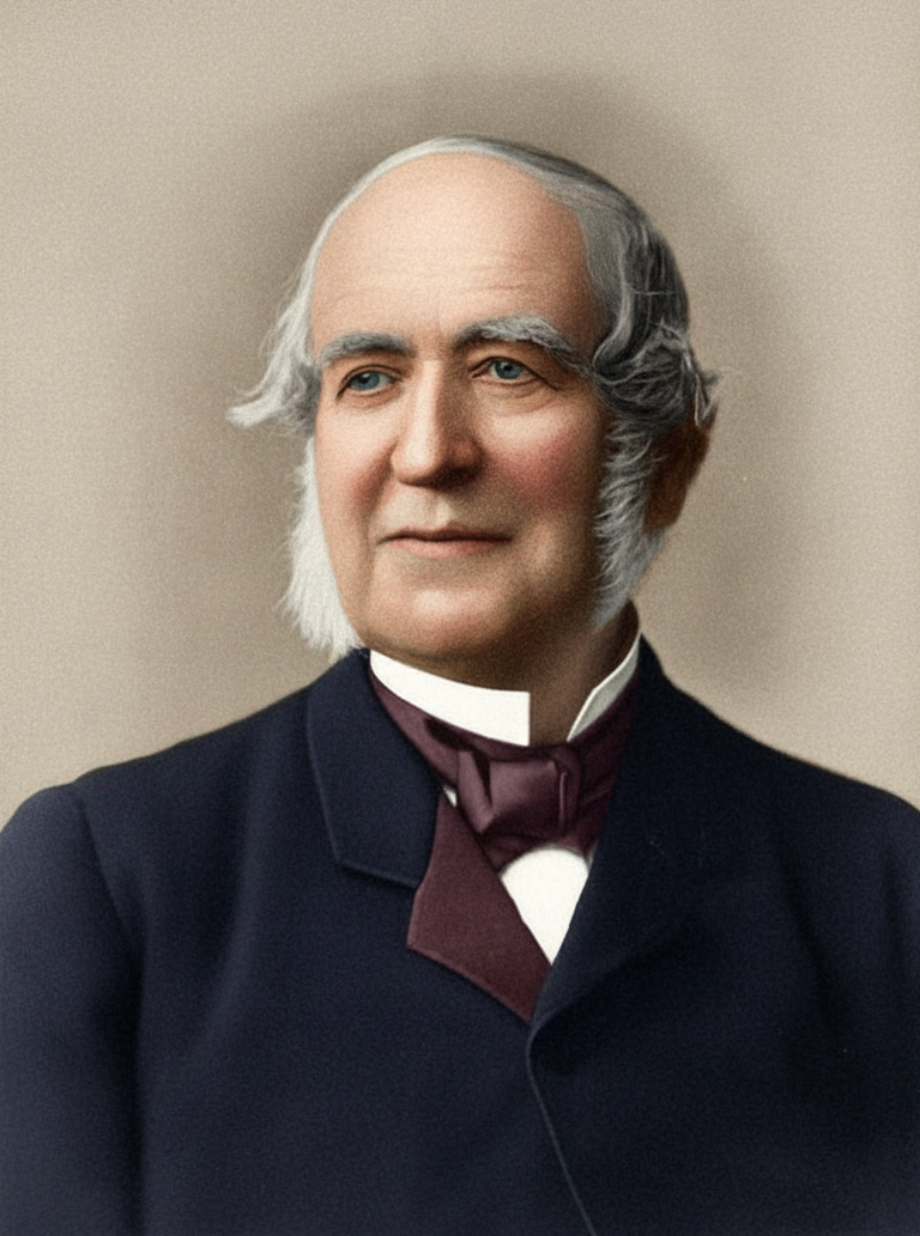
- Years of Life: 1807-1896
Early Life and Family Influence
John Morley was born on 4 June 1807 at Homerton, Hackney, London, and resided in the same parish until his home-call nearly ninety years later. He was the eldest of three brothers, the others being Samuel Morley, M.P. for Bristol—whose life was later recorded by Edwin Hodder—and William Morley of Bow. In the Lord’s good providence, the three brothers, long united in life and service, are now reunited in Christ.
The atmosphere of the Morley home exerted a formative influence on John’s character. His mother’s gracious love and courtesy, and his father’s unblemished integrity and cultivated mind, deeply shaped his early life. The family home was frequently visited by eminent Christian ministers and workers, and thus the Morley sons enjoyed personal fellowship with men such as Dr. Binney, Dr. John Pye Smith, John Clayton, James Parsons, and others whose example and instruction left a lasting impression.
Business Career and Christian Testimony
Leaving school in 1823, John Morley entered the world-renowned firm of I. & R. Morley, manufacturers and wholesale drapery warehousemen. For thirty-two years he devoted himself with integrity and diligence to the upbuilding of what became known as the “House of Morley.” Through the combined exertions of John and Robert Morley and their sons, the firm rose to a position of exceptional prosperity and reputation in London.
Within the business, John Morley exercised a remarkable moral influence. He was greatly respected by the young men of the house and regarded with affection throughout the establishment. Upon his retirement in 1855, he gave tangible expression to his concern for both the temporal and spiritual welfare of the employees. He wrote a personal letter to each worker, contributed £100 toward enlarging the library, presented a family Bible to the porters, and bestowed various gifts, combining generosity with pastoral thoughtfulness.
Freedom for Full-Time Christian Service
Released from business responsibilities, Mr. Morley devoted himself wholeheartedly to the Lord’s work, travelling widely throughout Britain and Europe. A decisive turning-point came during a visit to Ireland in 1859, a year marked by widespread revival.
Met at Kingstown by J. Denham Smith, a former guest at the Morley home, he was urged to travel north and witness the revival firsthand. Mr. and Mrs. Morley soon found themselves amid powerful manifestations of the Holy Spirit. In these scenes they came to see foundational truths of Scripture in a new light, learned much of the will of God, and returned to London with renewed purpose to consecrate time, talents, and substance entirely to the service of Christ.
Revival Fellowship and Wider Ministry
The years 1859–1863 proved especially significant, not only for blessing, but for the gathering together of many men later mightily used of God. Among those influenced during this period were R. J. Mahony, W. T. Crosbie, F. C. Bland, George F. Trench, Alfred Trench, Townsend Trench, and T. Shuldham Henry, several of whom were later closely associated with Mr. Morley in London.
J. Denham Smith was soon invited to conduct meetings in London, beginning with drawing-room gatherings in the homes of John and Samuel Morley. These expanded to larger meetings at Freemasons’ Hall, with more private Bible readings at Wood’s Hotel. The substance of these readings was later published as Life Truths, a volume that proved a blessing to thousands, including D. L. Moody.
From London the work extended to Brighton, Bath, Croydon, St. Leonards, Liverpool, Shrewsbury, and other English towns, as well as Paris and Continental centres. The Times of Refreshing Hymn Book arose out of the spiritual atmosphere of this period.
The Iron Room and Clapton Hall
Mindful of the Lord’s injunction to “Go home,” Mr. Morley erected the Iron Room at Upper Clapton, opened in 1867. It quickly became a centre of rich evangelistic blessing. Many well-known servants of Christ—among them Denham Smith, Shuldham Henry, William Lincoln, H. W. Soltau, Henry Heath, and others—assisted in the crowded services.
As the work expanded, Mr. Morley erected the more substantial Clapton Hall at Stoke Newington, opened in February 1880. The opening services included ministry from Denham Smith, William Lincoln, Henry Dyer, and others, and were later honoured by a visit from George Müller of Bristol.
Though not a public speaker of marked power, Mr. Morley’s influence was profound. His genial smile, warm handshake, kindly inquiries after body and soul, words of counsel, and the ever-present Gospel booklet bore fruit whose full harvest will only be revealed in eternity.
Baptism and Assembly Life
For many years the subject of baptism had not greatly exercised Mr. Morley’s mind. A remark by Theodore Jones, however, led him to earnest Scriptural investigation. Convinced of God’s will, he and his beloved wife were immersed at Tottenham, receiving John 12:26 as their guiding word. Appropriately, a baptistery was included in the design of Clapton Hall, where many later testified to the truths of death, burial, and resurrection with Christ.
He was unfailingly present on the first day of the week to break bread, holding firmly to Christ as the true centre. On one occasion he remarked with characteristic simplicity:
“We don’t come here to remember one another, or to remember our work, but to remember Him.”
Love for the Printed Word and Personal Witness
Mr. Morley possessed a lifelong passion for circulating Christian literature. Vast quantities of books, tracts, and monthly papers—both for believers and the unconverted—were distributed under his direction. For nearly forty years, thousands of copies of the Herald of Salvation were scattered, month by month.
Yet he never left the work to others. Personal testimony was among his greatest joys. He delighted to quote John 3:16, adding simply:
“God loved—God gave—I believe—and I have.”
Closing Years and Home-Call
The passing of many beloved fellow-labourers—Samuel Morley (1886), Denham Smith (1889), Shuldham Henry (1893), Dr. Lazeron (1894), F. C. Bland, and others—deeply affected him. Gradually his strength declined, until in the opening days of 1896 he “fell asleep in Jesus.” His last words were a triumphant confession:
“My Saviour, my Saviour!”
On 8 January 1896, his mortal remains were laid to rest in Abney Park Cemetery, beside members of the Morley family, awaiting the Victor’s shout and the resurrection morning, when all shall be “for ever with the Lord.”
Legacy
John Morley’s life stands as a testimony to:
-
Christian integrity in business
-
Unwearied devotion to evangelistic work
-
Hospitality and generosity sanctified by grace
-
Quiet faithfulness in assembly life
-
Confidence in the simple Gospel
He may not have been a great preacher, but he was a great encourager, a great sower, and a great lover of Christ—and through him many lives were brought into lasting blessing.