
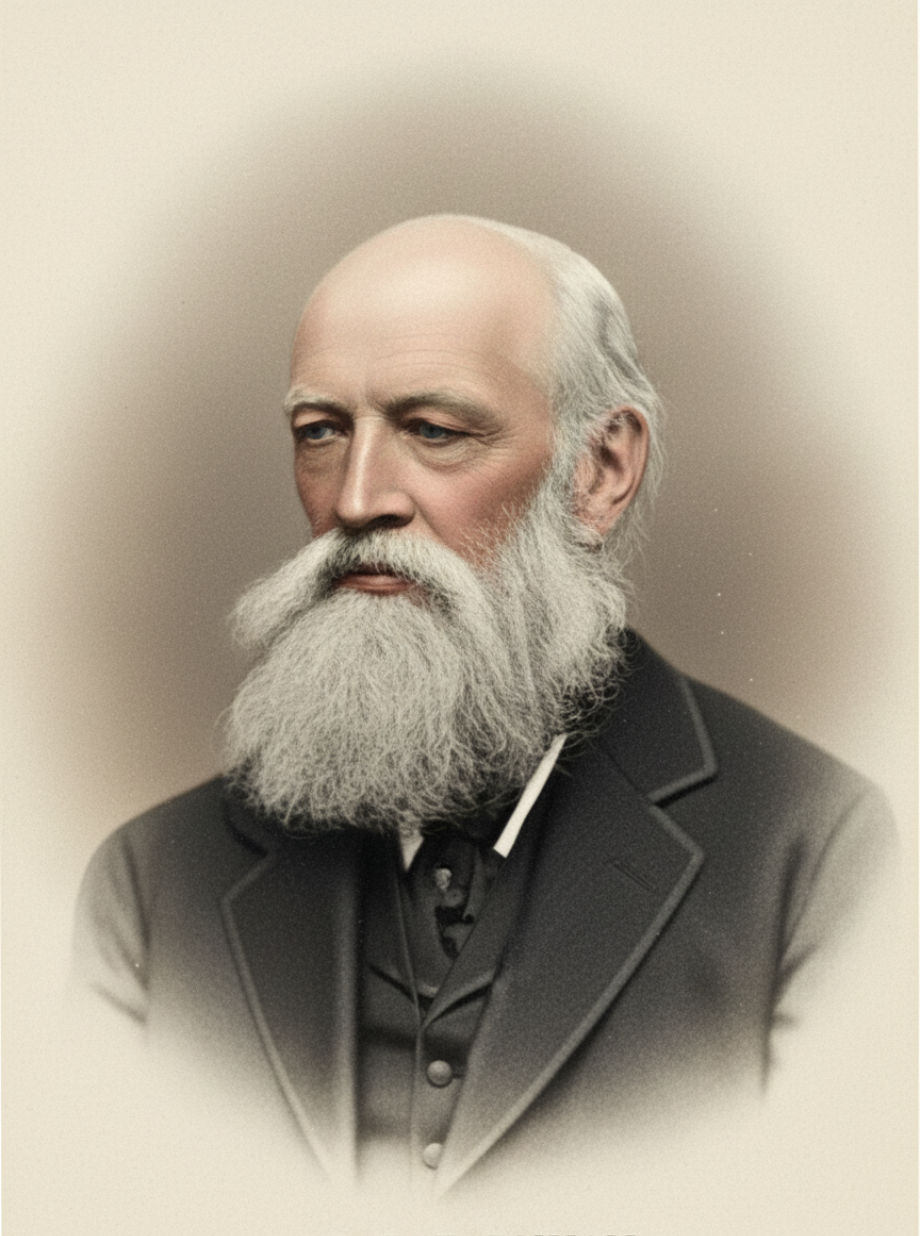
- Years of Life: 1803-1884
Early Life, Family, and Rank
Somerset Richard Maxwell, later the eighth Baron Farnham, was born in Ireland on 18 October 1803. He belonged to a family of ancient lineage, claiming descent from Henry III and subsequent kings of England. His father was The Rev. The 6th Baron Farnham, and his mother Lady Anne Butler. From birth, therefore, Maxwell stood among the aristocracy of Ireland, surrounded by privilege, responsibility, and public expectation.
Yet throughout his life he repeatedly affirmed that his highest honour was not inherited rank, but that he had been “adopted into the family of the great King and made an heir of God and joint-heir with Christ.” This conviction governed his priorities and shaped his entire course.
Conversion and Spiritual Priorities
Converted in early life, Somerset Maxwell came to esteem “the reproach of Christ greater riches than the treasures in Egypt.” Though fully conscious of his social standing and civic duties, he deliberately subordinated them to the claims of Christ.
His temperament was self-effacing rather than assertive. He never pushed himself forward, even when his position might naturally have secured him prominence. Instead, he quietly devoted himself to Christian service—by voice, pen, and personal effort—seeking opportunities to honour the Lord rather than to advance himself.
Public Service and Political Life
Maxwell did not withdraw entirely from public responsibility. From 1839 to 1840, he served as a Member of Parliament for Cavan, and in 1844 he acted as High Sheriff of Cavan. He discharged these duties conscientiously, yet without ambition for prolonged political advancement.
Even while engaged in national affairs, his writings show that he viewed Britain and Ireland in moral and spiritual terms, believing that nations as well as individuals are accountable to God. This concern found expression in works such as Britain with Reference to God, addressed solemnly to the Church, the people, and the Throne.
Literary and Theological Contributions
Under the name Hon. Somerset Maxwell, before succeeding to the barony, he published sacred poetry and several significant theological works. His writings reveal a mind deeply instructed in Scripture and a heart occupied with the character of God and the nature of salvation.
Major Works
-
The Wells of Salvation (1865)
A comprehensive treatment of salvation in its many Scriptural aspects. Of this work a reviewer wrote:“We are drawn on and on by it until the gifted and devout author exhibits the depth and breadth of that wonderful word ‘salvation’ as it is rarely exhibited.”
A leading minister testified:
“I have found in a few pages of this volume suggestive matter for ten sermons.” -
Atonement, the Only Efficient Exponent of God’s Love to Man (1866)
A searching exposition of the Cross as both the revelation of divine love and the motive power of human love toward God. -
Realities (referred to in the biography)
A work emphasising eternal truth over outward profession.
In addition, he authored writings addressing social and ecclesiastical issues, including education and church support in Ireland, always from a standpoint governed by conscience and Scripture.
Fellowship with the Brethren
Somerset Maxwell was closely associated with the believers commonly known as the Brethren, and his presence was specially valued at the Dublin Believers’ Meetings. His contributions were marked by spiritual weight rather than frequency or display.
As Hon. S. Maxwell, he was one of the three trustees of Merrion Hall, Dublin, when it was built—an indication of the confidence placed in him by fellow believers. Later, after succeeding to the title of Lord Farnham, he continued to use his influence quietly but effectively for evangelical work.
In 1874, he convened the Dublin meeting at which the Irish Evangelisation Society was formed, thus lending both his name and active support to the spread of the gospel throughout Ireland.
Succession to the Barony
In August 1868, Maxwell succeeded his elder brother Henry Maxwell as the eighth Baron Farnham, following Henry’s tragic death in a railway disaster at Abergele, Wales. From that time forward, he bore the title of Lord Farnham, yet his manner of life remained unchanged—simple, restrained, and governed by Christian principle rather than aristocratic display.
Marriage and Personal Life
Lord Farnham married twice:
-
30 May 1839 – to Dorothea Pennefather (1824–1861), daughter of the eminent judge Richard Pennefather and his wife Jane Bennett.
-
31 May 1864 – to Mary Anne Delap (d. 1873), daughter of Samuel Delap of Monellan Castle, County Donegal.
Notably, his two wives were cousins, their mothers being sisters. Both marriages were childless, and Lord Farnham left no issue.
Character and Spiritual Influence
Those who knew Somerset Richard Maxwell recognised in him:
-
deep reverence for Scripture
-
doctrinal clarity combined with spiritual warmth
-
humility consistent with his confession of Christ
-
steadfast devotion to gospel work
Though of noble birth, he consciously chose a lowly place among the saints, valuing fellowship with believers above social distinction. His influence lay not in command, but in quiet faithfulness.
Death and Legacy
Lord Farnham departed to be with Christ on 4 June 1884, aged 80. As he left no children, the title passed to his younger brother James Maxwell.
Legacy
Somerset Richard Maxwell, 8th Baron Farnham, is remembered as:
-
an aristocrat who rejoiced more in adoption into God’s family than in noble descent
-
a thoughtful theologian and devotional writer
-
a supporter and counsellor among the Brethren in Ireland
-
a servant of Christ who united public responsibility with spiritual humility
-
a man who used rank, intellect, and means not for self, but for the Master
His writings, especially The Wells of Salvation, continue to bear witness to a life governed by the conviction that Christ is the supreme reality, and salvation the richest theme the Scriptures unfold.