
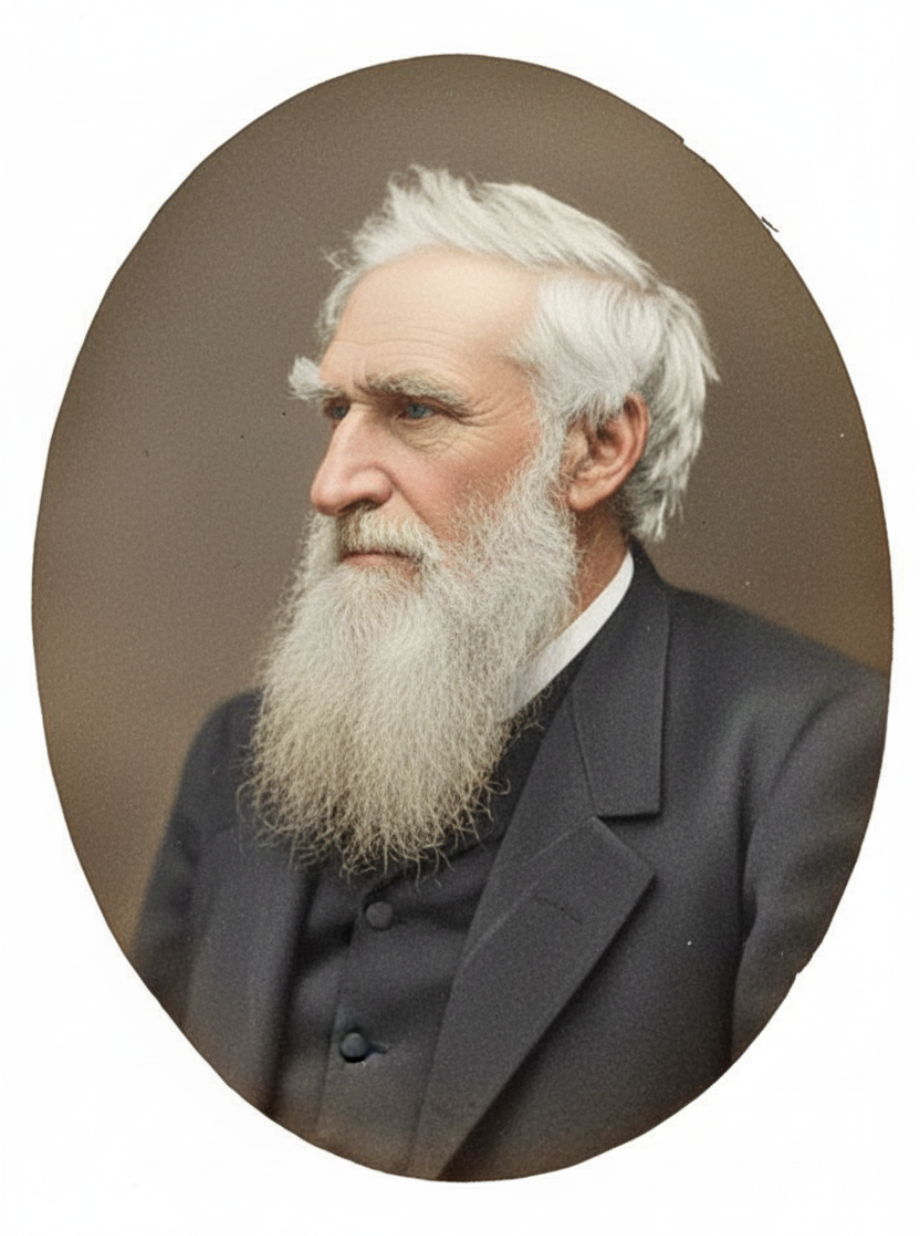
- Years of Life: 1797-1874
Early Life and Naval Service
Leonard Strong was born in 1797 into a clerical household; his father was Rector of Brampton Abbots, Herefordshire. At the remarkably young age of twelve and a half, he entered the Royal Navy, serving as a midshipman during the French and American wars. His naval career was marked by repeated exposure to danger, and he was many times in action, experiences that shaped both his discipline and seriousness of character.
While on duty in the West Indies, Strong narrowly escaped death when his shore-going boat capsized during a squall. This incident proved decisive. Confronted with his mortality, his sins were brought vividly before him, and he cried to God for mercy. Preserved from drowning, he left the Navy, deeply affected by the spiritual awakening that followed.
Education, Conversion, and Anglican Ministry
After leaving naval service, Leonard Strong went to Oxford, where he was converted and developed a strong desire to devote his life to Christian service. With missionary aspirations, he entered the ministry of the Church of England and was ordained as curate of Ross-on-Wye.
Yet his heart increasingly turned back to the West Indies. Responding to what he believed to be a divine call, he sailed in 1826 to British Guiana (Demerara), where he became Rector of a parish.
Missionary Work in British Guiana
Strong’s ministry in British Guiana was remarkably fruitful. He preached with power and compassion, devoting himself especially to work among the enslaved population. His advocacy and pastoral care brought him into direct conflict with the plantation owners, whose hostility escalated to the point that they threatened to shoot him. Eventually, through their influence, Strong was removed from his parish.
Undeterred, he relocated to Peter’s Hall and Georgetown, where he resumed his work with renewed vigour. His ministry continued to flourish, and many were converted under his preaching.
Separation from the Church of England and Early Brethren Principles
During these years, Strong engaged in diligent and independent study of Scripture. This led him to convictions regarding worship, ministry, and church order that he found impossible to reconcile with his position within the Church of England.
Long before the Brethren movement took public shape, Leonard Strong and Anthony Norris Groves, though separated geographically, were reading the same Bible and arriving at the same principles. Acting in obedience to conscience, Strong resigned his living, worth £800 per year, and surrendered his manse.
He then began to meet simply for worship among his converts, many hundreds of whom followed him. The first gathering was held in a large coffee-drying shed, with an estimated 2,000 people present. Another assembly was soon formed in Georgetown.
Significantly, believers in Georgetown were breaking bread earlier than assemblies in Dublin or Plymouth, making Strong’s work one of the earliest practical expressions of Brethren principles anywhere in the world. These assemblies have continued to the present day.
Return to England and Later Ministry
Leonard Strong finally left Demerara in 1848 or 1849 and settled at Torquay, where his ministry was highly valued. From there, he exercised a wide teaching ministry, particularly appreciated for its spiritual depth and warmth.
He became known as a gifted writer and teacher, producing numerous tracts and books, including works on prophetic subjects. His Lectures on the Book of Daniel (1871) became especially notable, and he was a frequent and welcome speaker at prophecy meetings in London and elsewhere.
Strong was also one of the first contributors to the missionary periodical Echoes of Service in Many Lands, reflecting his lifelong concern for the gospel’s advance among unreached peoples. The needs of “regions beyond” never lost their hold upon his heart.
Writings
Leonard Strong’s written ministry included:
Books & Pamphlets
-
Gospel Reminiscences in the West Indies
-
A Personal Testimony to the Truthfulness of C. H. Spurgeon’s Witness (1865)
-
Lectures on the Book of Daniel (1871)
-
A Lily Early Gathered; or, The History of Samuel Palmer (1855)
Articles
-
A Letter to Young Believers
-
The Kingdom of Heaven and Its Mysteries
-
The Present Mysteries of the Kingdom of Heaven
-
The Transfiguration
-
Who Are the Priests? (Rev. 1:5–6)
These writings reveal a man deeply exercised in Scripture, prophecy, missionary responsibility, and practical Christian life.
Character and Death
Leonard Strong was described as a man of rich gifts and rare grace, greatly beloved by those who knew him. His life combined courage, tenderness, scholarship, and missionary zeal, united by unwavering obedience to Scripture.
He died in London in 1874, aged 77, but was buried in Torquay, where he had lived and laboured faithfully since leaving the West Indies.
Legacy
Leonard Strong’s legacy is both historical and spiritual:
-
A pioneer of Brethren principles outside Europe
-
One of the earliest leaders to establish assemblies on New Testament lines
-
A courageous missionary among the enslaved
-
A gifted prophetic teacher and writer
-
A lifelong advocate for missionary work
His life stands as a powerful testimony to obedience of conscience, devotion to Scripture, and sacrificial service for Christ, long before such paths were widely recognised or understood.